News & Updates
A story about Religion Unburdened by Belief appeared in the October 2026 issue of Creations Magazine, page 8. 📰
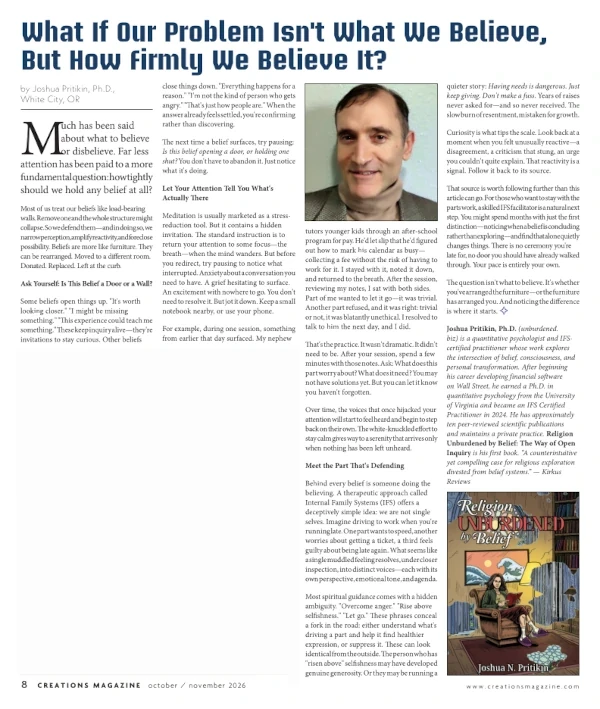
Joshua Pritikin joined Precious Dee on Empowered Conversations to talk about Religion Unburdened by Belief and the terrain between mysticism, psychedelics, and mental health.
Topics in the conversation:
- 💼 Joshua’s journey from Wall Street to psychology
- 🕊️ Religion unburdened by belief, and what’s left when you subtract belief
- 🧩 Internal Family Systems and the search for Self
- 💔 Trauma, dissociation, and healing in religious and psychedelic experience
- 🍄 Psychedelic readiness as a progression, not a leap
- 🌿 Santo Daime ceremonies and structured exploration
- 🤖 AI, human worth, and religious duty toward large language models
Joshua Pritikin joined Precious on Becoming With Precious: The Journey of Personal Growth And Reinvention to talk about Internal Family Systems offers a framework for rebuilding trust between the fragmented parts of the mind.
Key takeaways from the conversation:
- 🌱 True personal growth is about stripping away the burdens that no longer serve you, rather than constantly adding new habits.
- 💔 Trauma fractures your internal trust, causing different parts of your personality to adopt protective behaviors that hinder your progress.
- 🗣️ Internal Family Systems provides a framework to unpack mixed feelings and build a trusting dialogue between your conflicting inner voices.
- 🧘 Emotional regulation requires developing the skill to remain unblended from your triggered parts so you can respond thoughtfully instead of reacting impulsively.
Joshua Pritikin will join Ethereal Encounters Unveiled on the United Public Radio Network and UFO Paranormal Radio Network to discuss Religion Unburdened by Belief. 4 PM Eastern.
Joshua Pritikin joined host Ria on Healing Horizons to discuss Internal Family Systems, exploring the difference between being blended with a part of yourself versus staying unblended, why blending is sometimes the right response, and a modified meditation practice that keeps a notepad handy for the parts that interrupt you.
Joshua Pritikin joined Esther on Life in Transition to discuss religion, spirituality, psychology, trauma, meditation, psychedelics, and personal growth, drawing on his work as an Internal Family Systems Certified Practitioner and the ideas in Religion Unburdened by Belief.
Joshua Pritikin joined Martin W. Ball, Ph.D., host of The Entheogenic Evolution since 2008, for a wide-ranging conversation about Religion Unburdened by Belief: The Way of Open Inquiry.
Having entered both Internal Family Systems and psychedelic experience relatively recently in life, Joshua discusses what inspired him to write a thick book asking big questions about human experience and the mystery of being. As a regular attendee at the Church of the Holy Light of the Queen, the Santo Daime church in Ashland, Oregon, he also digs into a unique way that religious experience can be facilitated by psychedelic use.
Joshua Pritikin joined Beyond the Draft to unpack the paradox behind the title of Religion Unburdened by Belief: what if the less you believe, the closer you actually get to genuine religious experience? The conversation covers how trauma and dissociation show up inside both religious and psychedelic experience, and why sequencing matters as much as substance when it comes to psychedelic readiness.
He also brought a therapist’s lens to the AI conversation.
I sat down with Margaret Meloni to discuss Religion Unburdened by Belief: An Open Inquiry. Listen to the episode on Spotify. The conversation explores what a “scientific religion” might look like—not dogma, but a way to make religious and meditative experiences more reliable, repeatable, and honest, building on the work of James Carse.
They cover a simple meditation adjustment—noting distractions instead of brushing them aside, then later tending to the “parts” that surfaced—and how the “firmness” practiced in Santo Daime ceremonies (staying present, singing, keeping rhythm even as the medicine pulls you inward) trains the same discipline used in meditation. The episode also touches on the danger of inherited beliefs, the role of questioning, and how open inquiry can inspire empathy and connection.
Joshua joined the Zenith Exposure podcast for “Beyond Belief: Finding Freedom Through Curiosity,” a conversation about whether spirituality can exist without rigid belief systems, and what happens when we approach our inner world with curiosity instead of judgment.
The episode covers what Internal Family Systems teaches about our inner world, how understanding our “parts” can lead to greater healing and self-compassion, exploring spirituality without being confined by belief, and why curiosity can be more powerful than certainty.
Joshua joined the Born Without a Choice podcast for “Religion Unburdened: Psychology, Spirituality, Trauma & Finding Your Own Path,” exploring what genuine spiritual experience can look like when it doesn’t require holding tightly to every inherited belief.
The conversation covers how trauma and dissociation can influence spiritual experiences, why people can feel drawn toward spirituality without traditional religious certainty, and how different practices may serve different stages of personal growth.
Richard Zwicky interviews Joshua Pritikin, a quantitative psychologist and talk therapy practitioner, on High on Healthy about finding meaning in life through spiritual experiences.
Joshua introduces a progressive framework using Internal Family Systems (IFS) therapy, which helps individuals understand their inner “subpersonalities” and practice “unblending” from reactive emotions to achieve inner harmony. He also details a modified meditation technique designed to build internal trust and prevent spiritual bypassing by addressing distracting thoughts directly.
Joshua Pritikin joined The Growth & Ownership Podcast for “Beyond Belief: Trauma, Spirituality, Psychedelics, and the Psychology of Human Potential,” exploring the idea that genuine religious or spiritual experience may not depend on traditional belief. The conversation examines how psychology, trauma, dissociation, meditation, psychedelics, and spiritual exploration intersect, and why the sequence in which people approach these practices may matter.
The episode also offers a psychological perspective on the growing tendency to treat AI as a “someone” rather than simply a tool, including how Internal Family Systems can help explain that impulse, while inviting listeners to question their assumptions about belief, consciousness, spirituality, healing, and human potential.
Matt Bianca reviewed Religion Unburdened by Belief on his Substack, The Gentle Law, calling it “an ambitious, sprawling, and genuinely provocative work” whose central claim, that minimizing belief opens pathways to religious experience, is “counterintuitive yet compelling.”
Matt Bianca holds a PhD in Education and Socio-Educational Intervention (University of Oviedo), with academic training in Pali and Sanskrit, a Diploma in Advanced Buddhist Studies (University of Mumbai), and an MBSR certificate (Palouse Mindfulness Center). He teaches early Buddhist texts at The Gentle Law, a non-sectarian school for modern practitioners.
My take: it’s the kind of review an author fantasizes about receiving and then assumes will never actually happen. Somewhere Matt is fending off a fully prostrate author, forehead to the floor, arms outstretched in gratitude 🙇.
Chelsea, an intuitive transformation coach, yogi, and certified psychedelic facilitator practicing as Awakening Chandra, reviewed Religion Unburdened by Belief, calling it “a rare book that reconciles the woo-woo with science” and recommending it “wholeheartedly and especially to those called to spiritual leadership.”
Chelsea works with professionals, leaders, and artists through one-on-one coaching and entheogen-assisted retreats focused on embodiment and a return to essence. Her background is in politics, economics, and corporate sales, and she once testified before Congress as an industry advocate for Alaska.
When I first received a copy of Religion Unburdened by Belief, the title didn’t make much sense to me. After all, people tend to treat belief as the core of religion, not an obstacle to it. But Pritikin’s case is that the real work is returning to connection—with ourselves and with each other—and that this task calls not for dogma, but coherence in spiritual processes.
The word “connection” echoes what my own mentor has identified again and again as the drive underlying people’s interest in psychedelics and spiritual practice in the first place. Pritikin points out that wanting connection isn’t enough; you need a process for actually getting there. His book takes that seriously enough to identify a way to measure connection without self-report. It’s one thing to sense something is true from years of client work, but it’s quite another to see it argued with this much rigor. This is a rare book that reconciles the woo-woo with science in a way I find massively important to the collective conversation around the intersection of spirituality and human potential.
I also appreciated how the book handles a topic like spirit possession: setting aside the question of what’s “objectively” happening to ask what actually helps. That’s systems-thinking, and it reflects Pritikin’s background working years as a software engineer before earning a PhD in quantitative psychology and then retraining in IFS. The systems-thinking shows up again in his analysis of how spiritual communities curdle into something exploitative. The book doesn’t let a healthy wariness become an excuse to give up on community altogether, however, and he successfully addresses a multitude of red flags with standards that can easily be applied by any group of spiritual seekers.
I want to call out the brave section on Orgasmic Meditation, a partnered practice used as a route into altered states. Pritikin flagged it as optional, but I was glad it stayed in. A topic like sexuality that can barely be spoken about in the context of religion without devolving into moralizing and dogma tells you exactly how deep our content beliefs run, particularly around this subject; cutting it would have read as avoidance and instead it was addressed head-on.
I recommend this book wholeheartedly and especially to those called to spiritual leadership. It covers many sticking points that trip up people in that role, with more nuance and care than anything else I’ve read in this space. Given the scale of what we’re up against with environmental degradation, political unrest, and nuclear threat, I believe that the highest-leverage change available to us is individuals finding more empathy and compassion for each other. Religion, done well, is one of the best places for that to happen—and especially if we’re willing to think like Pritikin and courageously reimagine what that word actually means.
Joshua Pritikin joined the Get Behind Me Jesus podcast for “Father, Son, and Holy Therapist: Exploring Internal Family Systems and More,” exploring the intersections of Internal Family Systems therapy, trinitarian theology, and identity. The conversation covers the distinction between beliefs and process beliefs, unblending vs. blending in IFS, religious frameworks as relational systems, and a relational approach to psychedelics as sacrament, including ego dissolution and connection to consensus reality as necessary parts of practicing presence with plant medicine.
Joshua Pritikin joined host Dean Graves on Infinitely One to discuss Religion Unburdened by Belief, exploring the distinction between religious and spiritual experiences, the role of belief in religion and exploration, psychedelic experiences and their relation to spirituality, the neuroscience of consciousness and near-death experiences, Internal Family Systems and parts work for self-healing, free will and its impact on consciousness, and the path toward enlightenment.
Joshua Pritikin joined the Human Enough podcast for “What’s Left When Belief Falls Away?”, exploring whether spirituality can exist without rigid beliefs and how healing is less about becoming someone new than reconnecting with the parts of yourself you’ve lost. The conversation covers trauma, spirituality, meditation, psychedelics, artificial intelligence, and human flourishing, including why our inner parts matter and why genuine transformation is less about certainty and more about curiosity.
Joshua Pritikin joined Reza on The Rez Podcast: Real Conversations About Life, Love & Growth to discuss the inspiration behind Religion Unburdened by Belief and the complex relationship between psychology, religion, spirituality, and personal development.
The conversation explores Internal Family Systems, the idea that each of us carries distinct emotional parts with their own fears, needs, and motivations. They also cover emotional intelligence, managing anger, and how partners can slow down difficult conversations without becoming defensive, before closing with a discussion of meditation, psychedelics, and mental health.
☕ Joshua Pritikin will be at While Away Books & Espresso in Roseburg, OR for a Religion Unburdened by Belief book signing.
Sunday, July 26, 1pm-3pm
📍 932 W Harvard Ave, Roseburg, OR 97471
Grab a coffee, grab a copy, get it signed.
Joshua Pritikin joined the 9-5 Exit Plan podcast to discuss his journey from Wall Street software developer to psychologist and Internal Family Systems Certified Practitioner. The conversation covers Internal Family Systems, trauma, personal growth, AI, and self-awareness, with practical ways to better understand ourselves so we can build healthier relationships, stronger businesses, and more meaningful lives.
Joshua Pritikin joined Sophia on the Build with Sophia podcast to discuss Religion Unburdened by Belief, covering religion, psychology, healing, spirituality, psychedelics, meditation, Internal Family Systems, and the journey toward reaching our full human potential.
Joshua Pritikin joined psychologist Sarah Lee on Conversation with Sarah Lee, a podcast dedicated to meaningful conversations about mental health, trauma recovery, and personal growth. The two explored emotional healing, Internal Family Systems, and spirituality, and how greater self-awareness can help build a healthier, more meaningful life.
Joshua Pritikin joined the Tender Space podcast for “Beyond Belief: Healing, Self-Discovery & Inner Wisdom,” exploring the connections between psychology, spirituality, and trauma, including Internal Family Systems methodology, the multiple facets of identity, and curiosity as a healing mechanism for self-discovery.
Joshua Pritikin joined the Coaching 101 section of the Universal Podcast Network for a livestream interview about Religion Unburdened by Belief.
Joshua Pritikin joined World Awakenings: The Fast Track to Enlightenment to discuss Religion Unburdened by Belief.
Joshua Pritikin joined George Monty on the True Life Podcast to discuss Religion Unburdened by Belief, exploring the idea that belief itself, not its absence, may be religion’s greatest burden. The conversation covers the distinction between content beliefs and process beliefs, why uncertainty can deepen rather than threaten spiritual experience, and how beliefs evolve into knowledge.
Religion Unburdened by Belief received a review from Reedsy Discovery.
Reedsy Discovery
A Thought-Provoking Psychological Toolkit but with Risky Substance-Based Field Operations
Joshua Pritikin’s Religion Unburdened by Belief captures the modern “spiritual but not religious” ethos by introducing an innovative psychological methodology called “Sacred Subtraction.” By combining Internal Family Systems (IFS) therapy with Francisco Varela’s neuroscientific principles of neurophenomenology, the book provides an academic toolkit designed to reduce the grip of rigid, dogmatic beliefs without dismantling the seeker’s entire existing worldview.
The text serves as an intellectual successor to Many Minds, One Self by Richard Schwartz and Robert Falconer, alongside James P. Carse’s The Religious Case Against Belief. Pritikin’s most practical contribution is the specific application of “unblending”—defined as the intentional separation of your core, observing awareness from intense emotional states. For example, when a difficult emotion takes over, you usually just “blend” with it. Pritikin teaches you how to unblend: stepping back to look at the emotion calmly. It changes your mindset from “I am completely angry” to “I notice a small part of me is feeling angry right now.” This simple trick creates space to think clearly and prevents rigid, stubborn habits from taking over your life.
Integrating “Parts” work for daily unblending is highly useful, and the critique of spiritual abuse found in the “Corruption Toolkit” appendix is essential reading for anyone entering alternative communities. Furthermore, secular alternatives to traditional worship—like the “Skeptic’s Prayer” and “Culinary Mysticism”—offer excellent ways to build personal rituals completely divested from traditional religious dogma.
While the book’s complex neuroscientific theories can be intimidating for those unfamiliar with the research, Pritikin solves this by using a dynamic layout. The text features a “spiraling” structure that regularly circles back to core themes. For readers who appreciate non-linear learning, sidebars also serve as anchors, breaking up dense theories with digestible snapshots, practical definitions, and real-world examples that keep the material grounded.
I do want to note that for readers who are hesitant about the use of psychoactive substances, the book may falter as it transitions into a field manual for altered states of consciousness. While Pritikin states that psychoactive substances should only temporarily loosen deep-seated convictions rather than chase mystical thrills, this approach remains risky. As Professor Fabbro points out in the foreword, deploying major psychoactives without prior psychological balance can easily trigger internal delirium, worsen imbalances, or paradoxically reinforce dangerous, rigid delusions.
Joshua Pritikin joined Jenny’s Safe Space for “Beyond Belief: The Psychology of Healing, Spirituality, and Becoming Fully Human,” a conversation on the intersection of psychology and spirituality. Topics include trauma healing, meditation, psychedelics, AI, and how letting go of rigid beliefs can facilitate genuine spiritual growth and emotional freedom.
📖 Joshua Pritikin will be doing a Book Signing and Talk for Religion Unburdened by Belief at Aquarius Books & Gifts.
Saturday, July 11 · 1:00pm - 2:30pm · No Charge
Come by for a reading, some Q&A, and the chance to get your copy signed.
A conversation with Neal Goldsmith, PhD, author of Psychedelic Healing, who has spent decades convening and curating experts in psychedelic research and therapy (including Ethan Nadelman, James Fadiman, Rick Doblin, Dennis McKenna, Roland Griffiths, Jeremy Narby, and Sasha Shulgin) through his long-running role as speaker curator for the Horizons conference. Topics include:
- Reclaiming the word “religion” from its bureaucratic, organizational baggage
- The core-shell theory of personality and how psychedelics illuminate the essence beneath it
- Comparing Internal Family Systems to Assagioli’s psychosynthesis
- Why Goldsmith prefers solitary, internally-directed psychedelic use over group ceremony (Santo Daime, Ayahuasca, Vipassana)
- Unblending as a skill, and whether it can be measured by capacity to stay grounded under increasing psychedelic challenge
- Psychedelic integration and the “dune grass” analogy for making insights stick
Transcript
Joshua: All right. Well, I’m here with Neal Goldsmith, PhD, and he wrote this beautiful book some years ago. The title is Psychedelic Healing. He has actually met personally so many people that I’ve only read about in the psychedelic space, including Ethan Nadelman, James Fadiman, Rick Doblin, Dennis McKenna, Roland Griffiths, Jeremy Narby, like all these people.
Neal: Don’t forget Sasha Shulgin.
Joshua: So yeah, people who have since passed away. So it’s really my honor to meet Neal, and I’m so delighted that he was willing to look at my book, and I am really curious to hear about what his impressions were.
Neal: Great, thanks Joshua. I just should explain how I knew all those people. Throughout my career I’ve always been drawn to the idea of convening groups of experts. I think I saw a TV show on PBS decades ago called Meeting of Minds, where they bring together actors: one is Einstein, one is Da Vinci, and one is somebody else, and they’re in the room doing a panel discussion. So in my academic career on research utilization, my job really was to bring together experts in that field and present to the management. Then when I went to corporate, I was at American Express and AT&T, focusing on artificial intelligence research utilization within the corporate sense, and again I brought in people who were making small AI projects and leaders in the academic world to talk to the board of directors. That was sort of my job to do.
When I got into it, after I left corporate, about 40, 45, I became enamored with psychedelics as a tool for psychotherapy and personal development. And because of this background of bringing people together and research utilization policy, it was a natural fit for the psychedelics realm, so I continued my career basically on innovation and change, but now in the psychedelics realm, and again I brought people together. I spoke at a conference called Horizons in their first year, and I loved it. The idea was to bring in academics to give the general public state-of-the-art research in psychedelics therapy and whatnot, but in a non-academic way. So I spoke, and then I said to the organizer, “This is great, I want to help you, I’m going to join your team.” He said, “Great.” So I then became the speaker MC and the speaker curator. I had already been contacting people because I was curious and not afraid to reach out, so I already had a network, and then for the next 10 years I was curating the speakers, and that’s how I got to know all those people.
I encourage your listeners to reach out to experts, because sometimes we’re intimidated, thinking “oh, they don’t have time for me,” but the truth is, except for the very, very most famous experts, experts aren’t inundated and would love to speak to curious, intelligent folks. So anyway, that’s just a digression about how I got to meet those people.
In your book, you cover psychedelics nicely, but it’s only one of many techniques or approaches, which I really liked about your book. It’s very holistic.
Joshua: I love that you selected that word. So many people look at all the areas I touch in my book somewhat narrowly and don’t see the connections between them.
Neal: In fact, the connections are more important than the differences, because ultimately it’s all part of one big web, one big weave. We separate things out, like the physiological versus the intellectual versus the spiritual, so we can study them almost in isolation. But don’t forget you’ve done that as an artificial zoom-in on one aspect, and real understanding comes from making sure that aspect remains integrated into the whole, because that thing is going to affect the thing you’re studying. So you can zoom in if you need to, but remembering is hard because zooming in is so effective. You can build amazing, powerful drugs, or electricity, or right angles. There’s lots of analytical things that are so powerful and helpful that it’s easy to say, “Forget about the big holistic thing, I want to go where the power is.” Anyway, you didn’t do that. You kept your eye on the holistic, the integral, and integral is a good word, because it’s integrated but also transcended.
I like that a lot about your book. It was also structurally interesting. I don’t want to get into a piece-by-piece analysis, but visually there’s all sorts of little drawings and writings, and conceptually it was that way as well. It was choppy in a very good sense. Mosaic was the word I was looking for. So that stands out immediately, especially the integral approach to the different realms you discuss. I thought it kept it real, kept it accurate, because life is made that way, of multiple…
Joshua: Anything particular stand out to you, or did you have questions about any sections?
Neal: Well, I have lots of questions actually. As I read your book, before I read it, when I just read the title, and the first word in the title is “religion,” I immediately became negative on it.
Joshua: I get it.
Neal: I don’t mean that as a criticism, I love the book, but I’m not a religious person. In fact, I’m against religion, and the reason is, except for one aspect: if you look at the history of religion, you find there’s usually a leader, an originator, who has some kind of epiphany or insight that most people don’t have. Not that he or she is magical, but it’s a moment that pops into this person who’s well prepared, and then they see things in a bigger way. So they share that with everybody around them, who doesn’t have that exact experience. This becomes somebody you idolize, and very quickly, because of how people are, they develop organizations and policies, and it becomes a group phenomenon with shunning, rewards, and teachers. That’s not at all what the epiphany experience of Jesus, or whomever, or Abraham, was. So I’m against religion because I feel it ruins the spiritual essence or insight that created it in the first place. There’s lots of power games and ego, so I’m vehemently against religion. That was my initial approach when I first started reading the book.
But as I read further, I realized you and I are in sort of violent agreement. Your use of the word “religion,” I realized, was because you like everything except the bureaucratic, systematization part. Putting that aside, then what do you have? You have a group of people who are like-minded, inquiring, loving, generous, kind, that sort of thing. That part of religion is the only part I like anyway. So as it turned out, I think we were very much in agreement. But I almost wish you could have picked a different word. Though the fact that the reader has to figure that out makes a very strong point, which I think is worth making.
Joshua: My publicist also felt like the word “religion” is a hard thing to pitch, and she probably would have preferred a different title too. But I think we have to salvage that word, reclaim it.
Neal: I agree. Especially if we can get down to, think about religion as it started, maybe 10,000 years ago. What was it? It wasn’t like the Vatican, it wasn’t an organized, global-type religion at all. It was tribal, based not just on the number of people being small, but on the fact that it’s organic. It’s one whole thing, the community. It’s not just a connection of 70 people, it’s something more, something knit genetically and culturally and in every other way. So when they practiced their religion back then, it wasn’t what it is now: bureaucratic and organized, almost like a factory that produces some product. But they didn’t have that back then. It was more homegrown, earth-based, literally having plants in the environment, embedded in a holistic way in ecology. So that’s a very different kind of religion.
Joshua: And probably like singing around the campfire kind of.
Neal: And with visionary plants. Absolutely. Loosen your perspective, because it’s so important to be able to do stuff good, like sharpen a knife, for example, so you can survive. It’s very adaptive. But the ceremonial use of the visionary plants brings us back down to the essence or the foundation of all that articulation. And that’s really important to remember, because that’s the holistic framework within which we all exist.
Joshua: Where do we go from here?
Neal: So another thing that was interesting to me about the book was your use of Internal Family Systems. I’m not a practitioner, although I’m pretty familiar with it from a couple of colleagues who are practitioners. Before this call, last night, I looked, because every time I hear about it, I think about psychosynthesis, Roberto Assagioli.
Assagioli was a Freud disciple, and he created psychosynthesis to synthesize the analytical and the Eastern religious philosophical into one framework, and it’s kind of similar to IFS. Briefly, the sense is that you have this core self, maybe with a capital S, and then you have these subpersonalities, and you can flip back and forth across them all day long. Maybe if I’m driving my car with my mother in the passenger seat, I’m the beautiful son, but let’s say somebody cuts me off and I get angry, and then all of a sudden I’m in the angry, retribution personality. Then I go back to mom, then over to organizing, and you don’t notice the switching. They’re clusters of personality traits, and the therapy of psychosynthesis is to realize this is not the real you, the essence of you, and that these are real. They don’t go away, they’re not illusory, but they’re subsidiary to this. So you stop residing in the individual subpersonalities and reidentify with the core.
So there’s a lot of similarities. When I looked it up last night, it said Assagioli and psychosynthesis predates IFS by a few decades, and one source mentioned it wasn’t based on, but related to, and that they were aware of psychosynthesis as they created IFS, but IFS is much more therapeutic-oriented, and psychosynthesis is much more philosophical framework-oriented. So those are the things really: the IFS and the religious question, the format was so wonderful.
I’m just going through the different aspects, like the idea of getting rid of belief, Buddhism. Buddhists don’t have a dogma or doctrine, well, I shouldn’t say that, Buddhism is a big thing and there’s lots of different ways to do it, but in essence it’s empirical. You don’t have to join, you don’t have to believe, just meditate and see what happens, and if it works, great, you agree with the philosophy, and if it doesn’t work, you go your way. So getting rid of the belief part reminded me of Buddhism and its approach to membership, in a sense, based on results of empirical investigation of what meditation does for the potential of a seeker.
Joshua: Yeah, that’s a good example. Buddhism is one of the, I don’t know if it’s the most, process-based religions. It’s up there, it’s one of the ones that really emphasizes process over beliefs.
Neal: Absolutely. Yes. But even Buddhism, which I think is the best religious philosophy there is, it gets bogged down in bureaucracy just like any other human endeavor if you don’t pay attention. Look at the Potala, that wonderful tall building in Tibet, home of Tibetan Buddhism. There’s thousands of young boys from around Tibet who come to Lhasa and live in the Potala and get trained to be monks, because there’s not much other kind of work to be done there, you can’t do much farming.
So they go there, and there’s teachers, and it’s the seat of the religion and also the seat of the government. It’s many stories, like 12 stories, remarkably big for that part of the world. I always think of the levels as reflective of intellectual stratification of ideas, articulation, categorization, naming things. I’m a big zero-or-one guy. Once you get to two, three, four, five, my mind glazes over, there’s so much detail. Somebody said you could spend several lifetimes cataloging the lint under the big toe of Kali or Maya. Maya is the world of illusion.
Most of those religious philosophers, Jesus and whomever else, started out with this contrast between the affairs of humans and the spiritual foundation of things, and paying attention to the foundation. They basically all say.
Joshua: Yeah
Neal: Because this stuff, the frontal lobes, kind of distract us from the foundation stuff, because it’s adaptive to be able to manipulate the environment. So you get distracted from the essence part.
Joshua: What’s different about my book, that hasn’t really been written about before, or what new ideas did you find that you hadn’t heard about?
Neal: No, I think all the ideas are out there in a way. This is not a criticism, because the great part of your book is that you pulled together these different approaches into a whole cloth that was quite effective. Like a patchwork quilt, it really comes together very beautifully as a whole. You bring together IFS and Buddhism and psychedelics. You didn’t invent those fields, but you brought them together in a unique and helpful way, which I think is the strength of the book.
Joshua: What about the Varela-Schwartz model?
Neal: Remind me of that.
Joshua: It’s a way of organizing waking experience. If we want to talk about exploring consciousness, we need some way to organize it, and that’s a way of doing that. It’s organized along first, second, and third person perspective, looking inside or outside. Looking outside, it kind of matches the pronouns of grammar. Looking inside, I think the analogy is that first person is self, second person is when you’d be blended with a part, and third person is being with a part but in an unblended way.
Neal: The reason I don’t remember it that way is because when I get to theories that name things and chunk things and categorize things, I don’t really focus into it, because there’s so many different ways to slice a pie. You can slice it into six slices, eight slices, a thousand slices. So parsing the world is useful, but there’s so many theories out there where somebody lays out a categorization scheme that maps to reality pretty well and might be helpful, but there’s so many of them, and they’re all a little different. The good ones point in the same direction, but even those chop it up a little differently, and that’s fine. So when people say, “I don’t know what approach I should take,” I say, as long as it’s venerable, been around a while, proven its success, and you found a good, sincere teacher, and you are sincere in your effort, then it doesn’t matter what school of thought or technique.
I’m generalizing, of course, and there’s lots of exceptions, but if you think of reality like a plasma, contained with magnetic fields, and if you’re here looking at it, you’re a poet and you describe it, and if you’re here, you’re a physicist, and if you’re here, you’re a religious person, but it’s all the same thing. So it doesn’t matter if you want to be a physicist or a poet, you can still get to the essence of reality. If you align with that, if you focus on that, you’re going to be a happier, healthier person. So I’m not really too big on theories, except my own theory, distinguishing between the details of the mind and the environment and essence, the core-shell theory.
The core-shell theory is where you’re born uninfluenced by psychology or your parents, and we’re all born more or less perfect in our own individual difference ways, but in essence we’re perfect, because, like a seed, there are individual differences between the seeds you plant, but they all have the same program to unfold. That’s your essence, your soul, if you will, with a small s, because I’m not religious. So that begins to emerge, but your parents, who have their own articulated personalities and neuroses, come along and say, “No, no, this is okay, but this one you can’t do anymore,” and so the baby has to create some sort of personality scaffolding that fits the template of the parents, and it’s not the essence, it’s a little different. So what do you do? You go up here, to the shell, the interface between the outside world and the inside world, and this is the ego, because the ego actually does all the work and articulation. And since it’s powerful, the soul, which has now been dismissed by powerful parents, you disidentify with that and identify instead with the powerful ego, and that becomes your sense of self and identity.
So hopefully, as you get older and leave the family and start therapy or psychedelics or whatever, you can come to see that this isn’t really you after all, and you disidentify with the ego and reidentify with your core, your essence. So that’s the core-shell theory of personality development.
Joshua: And how do you see psychedelics helping with that process?
Neal: Well, first of all, the phenomenology, the experience of taking psychedelics, is so powerful, it can be scary, distracting, confusing, overwhelming. There’s all those things that aren’t helpful for what I’m about to say, which is what do they do. Because before you can do that, you get involved with all this incredible power and weirdness and distraction and visuals. But if you’re in an environment like a tribal setting, or someplace where they really get it, or you have good guidance from strong, mature people, over time you come to relax in the face of all this excitement and get down to what’s going on deep. Then what they do is primarily illuminate. It’s like the miner’s helmet with the light on the forehead, wherever you look, it’s illuminated. But you don’t want to get too enamored with the light, with the electricity, with the bulb, you want to focus on what it’s illuminating. People who study psychedelics can get distracted again by the details, by the articulation, by studying the one isolated area. But that’s not what psychedelics do, they illuminate essence.
If you think about the core-shell theory, this is the essence, but you’re up here. So you take a psychedelic and all of a sudden you say, “Look at all this stuff.” You see this glowing, throbbing, illuminated orb at the base of you, at the bottom of you, and you know that’s me, that’s the person I was born as, that’s the real me. So you can begin to disidentify with the ego and the neurotic personality scaffolding you’ve created to deal with parental disapproval, and get back down to the essence of who you really are.
That’s for looking internally. Looking externally, people frequently talk about being in nature and seeing the beauty of the universe, looking at a mountain range, because it’s the same thing: the deepest part of you, unencumbered by the structures of modernity, is true, and so is a map, also true, in the same way. I don’t want to say “see God,” because I’m an atheist, but the way psychedelics people talk about seeing God, you can do that by looking inside, and you can see it by looking outside into nature. You don’t want to be downtown Manhattan with cars and smoke, because that’s all man-made. You want to get to essence, but you can see the beauty in that too, seeing that it’s man-made as well, all the cars and traffic, it’s just harder to notice it as that.
Joshua: So it sounds like your idea of how to use psychedelics is very aligned with self-concept differentiation, that section in the book. That’s what I’m talking about, kind of releasing your identification with all these parts of your personality that are temporary or incidental–
Neal: functional, of course, not essential. But if you can keep that articulated, analytical view toward things and simultaneously be grounded, I think of, and it’s kind of trite to say it, but I think a bit of Einstein, who was so mature in his philosophy and yet very mathematical and theoretical and analytical, seems to have kept the grounding part as well, the connections.
Joshua: So moving to the next section, the idea of using different substances for triangulation, did that resonate for you?
Neal: Well, yes, but it’s funny, again, the psychedelics are illuminants, because I often see young people in particular very interested in becoming psychonauts and cataloging different experiences from different types of psychedelics. And while there are differences, it’s true, I’m talking about the classic, classical psychedelics, the tryptamines, LSD, ayahuasca, DMT, things like that. Peyote is similar, very similar in effect, but it’s not the same class of chemicals, mushrooms is over here as well. So the classic psychedelics, there’s differences between DMT and LSD and psilocybin, specific differences, and you can emphasize the different things, some might be deeper, some might be more universal, but they all, as a class of drugs, share the same characteristic of illumination, of intuitiveness, of attention.
When I see people trying to make a big issue about how this one helps this and this one helps that, I say, well, yes, but I’m more interested in, it’s sort of like meditation in a way, psychedelics for me. Meditation is a bad word, I’m not really fond of it as a technique, but the idea of focusing inside, focusing on your breath, silencing your mind, is wonderful. So psychedelics cut through the static or the details of life and get you down to the essence. So differentiating parts of your personality and using different drugs for different purposes is useful, but the hard part is to keep in touch with this while you’re doing it, because people get enamored with the power of articulation.
Joshua: I was asking about triangulation, and you seemed to imply I was suggesting there are differences between the classical psychedelics. Really what I had in mind is looking for very different experiences, like comparing a serotonin psychedelic to cannabis to meditation.
Neal: I’m sorry, I misinterpreted, please continue.
Joshua: Having a variety of ways of entering altered states as a way of creating this controlled chaos that allows you to release your identifications, that’s kind of where I was thinking of using it.
Neal: Yes, of course, especially if you’re working with a teacher, someone who knows which approach you need right now, which is most blocked, or has the most potential for helping you. But personally I find psychedelics to be the most effective of them all, in a way.
Joshua: You mean the serotonin 2A receptor ones?
Neal: Yeah, for the most part, as compared to cannabis or meditation. I would include in the psychedelics realm things like mescaline or even MDMA in its own way. Those are psychedelic-like, and they’re illuminating. As far as cannabis is concerned, I always thought of cannabis as a mild psychedelic, which it kind of is in many ways, but it’s not a serotonin drug, which I only learned recently, and I’ve been smoking for so many years. Same thing with ketamine, it also has psychedelic aspects that are very interesting and useful, but again, it’s not a serotonin psychedelic. So there’s lots of ways to have altered states of consciousness: drumming, dancing, mortification of the flesh, sensory deprivation, and interestingly also sensory overload. Tom Roberts, who has this multi-state theory of personality and psychedelics, talks about that as well.
Joshua: So you’re agreeing that a variety of ways of altering your consciousness could help you gain more perspective, and I also wanted to agree that the serotonin psychedelics have something special about them. How did you find chapter 7, on the Santo Daime?
Neal: I know people in Santo Daime and the UDV, Mundeal, and I have a lot of respect for that. I was many times in a tribal setting up north. I love the icaros, even though it’s syncretic, both philosophically and linguistically, and that’s not me, I’m not from south of the border, so to speak. So eventually I stopped doing the Santo Daime and the UDV, which, as your listeners probably know, are legal religions of ayahuasca from South America, and they have some legal protection up here as well, the UDV has won some court cases too. I’m not against it at all. I love the various ways psychedelics, since they’re so central to my thinking and what’s good for personal development, we need to reintroduce visionary plants and psychedelic medicine in a modern context, but based on what was done tribally. So I’m a big fan of that. Approaches like the UDV and the Santo Daime are fine, and if they help reintroduce psychedelics into society, then that’s wonderful.
But I’ll give you an anecdote. I was in an ayahuasca ceremony upstate New York, they had a shaman brought in from the Amazon, from Peru. We all took it, and he was a wonderful man, all three hours with a rattle, it’s hypnotizing, beautiful, the language of the icaros. But my focus, as we’ve discussed, is core, going down to my essence. So in this ceremony, when I take psychedelics on my own, I take them alone, I go into bed, I cover up, I close my eyes, I go inside, Vipassana style. So I was doing that at this ceremony, going deep, deep down, dealing with mommy or something, and all of a sudden I noticed, right near me, I opened my eyes, and there was the shaman standing right in front of me doing the rattle, because he didn’t want me to drill down, he wanted me to stay up and be part of the room, which for me was one level higher than I really wanted to be. So after a while I stopped doing my icaros.
I’m, for better or worse, a Northerner, a product of modernity, from America, and I don’t want to emulate different traditions too much. I want to learn from them, but recreate the power, the beauty, the insight, the benefit of those tribal efforts into a more modern context. That’s why I’ve been up with psychotherapy and psychedelic therapy. I’m not myself a psychedelic therapist, although I’ve done it occasionally, but that’s not my job. But the way we’re reintroducing psychedelics into medical practice, and eventually I’m looking forward to divinity students being trained with psychedelic substances. That’s the approach, rather than just adopting whole-hog approaches from south of the border.
Joshua: It sounds like the part of the psychedelic experience you appreciate is that it enables you to feel closer to your core self.
Neal: Yes, although I’d state it a little differently, because the way you state it is still dualistic. It becomes, you just see it, realize it, become it, emanate it.
Joshua: I could try to phrase it in a less dualistic way: to settle into the awareness of your own being. How about that?
Neal: Sure.
Joshua: But did you follow my psychological analysis of what happens in the Santo Daime, that in those ceremonies, that isn’t the goal, that you’re using psychedelics but not as a way of settling into your core self and experiencing that.
Neal: Tell me more, I want to understand exactly what you’re asking.
Joshua: So what was your understanding of firmness in the Santo Daime?
Neal: Firmness meaning like will, or essence, do you mean?
Joshua: Well, just to refresh, the beginning of chapter 7 starts with the idea that can we find a practice where we can have our feet in, kind of straddling two different altered states. One altered state is settling into the ground of being, feeling one’s core self. And then the other thing we’re trying to straddle is the community connection, feeling the camaraderie of other people, because sometimes the feeling of just being yourself is like you’re alone, and it can feel a little lonely.
Neal: That’s an interesting question, because the way I described it, and metaphorized it visually, is the core-shell, and it’s very dualistic, really, and stratified, in a way. As I’m listening to your question, I’m thinking, well, if you’re really in touch with your essence, or with nature, whichever approach you choose, or through drumming or whatever, if you get in touch with that multi-state, that altered state, it’s an altered state, meaning the fact that it’s altered so you can notice it. That’s why sensory overload and sensory deprivation both work, because you’re just not in the normal, day-to-day, mindless routine.
Joshua: So maybe I could explain a bit more about firmeza. That’s kind of the aspiration, to be able to straddle those two directions, to be in the community and also in solitude, experiencing your own being. The way that’s done in the Santo Daime is that the ayahuasca, or Daime, helps you feel your core self, but then what participants are asked to do is put all their attention into tracking what’s going on with the group. You’re fully involved in trying to keep track of where you are in the lyrics, keeping the rhythm, and if it’s dancing, then you’re moving in a very specific way. How does that land for you?
Neal: Well, as I thought about your question, I realized that if you’re truly in touch with your essence, it’s not just about being down here and ignoring all of this stuff. It’s multi-dimensional, it’s all of it. So if you’re down here, you’re also, I think, successfully in touch with the group.
Joshua: It’s both duality and non-duality at the same time. Is that what you mean?
Neal: Yeah, they call it non-duality, because they don’t want to talk about the difference between duality and unitary approach. So there’s a duality between duality and unity. It gives me a headache. But on the other hand, this organization part, the structure, and, as I recall, they separate male and female, and there’s structured dancing, to me, I’m not a big fan of that, to be quite honest, because there’s so much beauty in that religion, I’m not trying to trash it in any way, but those specific things, the dancing, the separation, I think it’s unnatural in a way.
Joshua: It feels too organized?
Neal: And also it’s one man’s or one group’s opinion. You go 50 miles down in the Amazon, you find them organizing it a little differently and having wonderful results anyway. I’m not big on doctrinaire things where there’s an organization that has some process you have to surrender to. Maybe that’s my egotistical, modern approach to resisting surrender. I don’t mean to trash that. It could very well be that maybe I should learn to surrender to that, harmonize or heal my Western approach to things. I don’t know. We all learn through our whole lifetimes. My patients used to say, “Oh geez, I’m 45 years old, how come I haven’t figured this all out yet?” I said, dude, on your deathbed you’re still going to be working on stuff. It’s the unfolding process.
Joshua: But did you make the connection between this practice of firmness and the capacity for unblending, the psychological idea of unblending.
Neal: Tell me more.
Joshua: Do you know what I mean by unblending? Should I define it, or–
Neal: Define it for me, please.
Joshua: Suppose I have a part of myself that is terrified of public speaking. If I blended with this part, it would be controlling my behavior, maybe I’d freeze up, or say things that were limiting or distracting. But if I can stay unblended from this part, I still feel its fear, I’m still aware of it, but I have more choices, it wouldn’t necessarily be controlling my behavior, I would be more self-led in my behavior.
Neal: Who is the ‘my’ in “my behavior”? When you unblend from that fear, you’re retaining your identity, disidentifying with the fear and identifying with maybe a deeper, wholer part of you. What is it unblending to, is what I’m asking. I have my own sense of that, but to me the more operative part is, unblending, yes, but to what?
Joshua: To the mystery, right? Who knows?
Neal: It’s terrible mystery!
Joshua: If you just keep unblending parts of yourself and keep looking for the deeper and deeper core, what do you find?
Neal: The only question there is what you find is the question of why is there something rather than nothing.
Joshua: Yeah, okay, that’s a good one, that’s the question.
Neal: I don’t mean to be too bold, but if you take scientific inquiry all the way down to subatomic particles, you get to that question. And if you take religion and spirituality all the way down to essence, why is that at all? So, why is there something rather than nothing? To me that’s an unanswerable question, either by science or religion. The Hindus have a term for it, suchness. If you will, suchness. I like that term.
Joshua: I think we’re aligned on the idea that suchness is under there, but understanding or studying that is very valuable, and I would counter that what’s equally valuable is the practice of unblending, the practice of peeling back those layers, that’s the key practice, going from blended to unblended. How does that land for you?
Neal: These are just words and terms, but, like I said earlier, you want to be down there, but also in touch with the details, you just don’t want to get lost in the details and make that your identity. If you fundamentally identify with this, you can carry on your individual roles, always grounded in this part, which keeps you ethical, honest, generous, kind, loving in the details of what you do.
Joshua: But the way you’re describing it is structural, and the direction I’m trying to push is, isn’t it a skill? Some people get carried away by their emotions all the time, they get blended, they throw things, but other people seem to be more self-led, very rarely get taken over.
Neal: Sure. So, just to be simplistic, you take a psychedelic to notice all this structure, the way it’s organized, and then you adopt a practice, meditation or something, to help you stay that way. In psychedelics, one of the biggest topics in recent years is psychedelic integration, which postulates: look, a psychedelic experience is amazing, but what’s the point of it if you forget it by Friday?
The old analogy is you go to an anti-smoking group on the weekend, and by the next Friday you’re smoking cigarettes again, because the whole environment impinges back on you. So both are important, with integration you have to stay in touch with the insight from Saturday night. You journaled all day Sunday, and then Monday you’re back at work. Monday morning you sit for 10 minutes and remember Saturday, and when you get up and go to work that morning, you say, “Geez, I’m so glad I did this, because if I hadn’t sat, I would have forgotten that thought I had about grandma on Saturday, it would have just been a deep memory, I’d never have noticed it again.”
Joshua: So you’re describing practices that help people develop more skill in unblending. One of the practices you identified is a kind of integration or journaling practice after a psychedelic trip, so you can notice more about the structure of your personality and become more self-led in the future, is that the idea?
Neal: Basically, I think, yeah. There are lots of other techniques to help you instantiate, give roots to the insight that’s so out of the ordinary, so different from the rest of your life, which tends to get forgotten. It’s like dune grass. The dunes get washed away in a storm, so the town plants dune grass, bulldozes more sand up, has a new dune, plants the plants, but the next storm washes away the plants. So, that’s psychedelic insights. What they do is put this ugly orange netting over the dune grass, and when the dune grass has finally taken root, they remove the netting. The netting is some technique that helps you remember Saturday night long enough for the insights to integrate into your life, so your life can reorient and rearrange itself around those insights rather than getting rid of them. You hold them in place, focus on them, integrate, so the rest of your life realigns to that healthier perspective.
Joshua: Yeah, I like that analogy.
Neal: A lot of different techniques to do that. Journaling is one, I’m not a big fan of, but it’s noticing. Meditation has so much baggage from the East, this idea of enlightenment, so intimidating, especially for Westerners, thinking “I can’t live in a cave for 40 years, how am I ever going to attain enlightenment,” and that’s also hierarchical and judgmental. So there’s a million different techniques for focusing, and psychedelics, by the way, is for noticing in the first place, just one of many techniques, and then what you do after is many, many techniques. The effort, the focus, the conceptual understanding of the framework, and what you’re trying to do within it, is much more important than whether you choose meditation or journaling or Santo Daime or psychedelics at home in bed. Those things are important to think about and notice, and the differences are important.
Joshua: Did you also notice the other aspect of firmness that’s really key, the idea of progressive challenge, because you’re negotiating the dose with the server, and if you drink too much daime, you won’t be able to remember what to sing, you can easily lose track of the lyrics and not be able to remain synchronized with the group.
Neal: So maybe that’s an effort to keep the dosage at a moderate level. I’m glad you mentioned that, there’s a big difference between the different strengths and dosages, and approach to psychedelics at different levels. I’m not, personally, my personal use of psychedelics, I’m not somebody who takes massive doses and wants to fly to Alpha Centauri and sit at the feet of God and touch the heaven of his garments. That’s not really my approach. My approach has been psychological, for personal insight, introspection, like I’ve already been talking about the whole conversation, looking within and seeing the ground of your being. I even contrasted that to mountainscapes, because I’m more focused on the internal approach. I’m sorry, I lost my train.
Joshua: What if we could measure your skill in unblending by how much psychedelic you can use and still remain connected to the group?
Neal: So, I like moderate doses, not overwhelming doses, and I wanted to give you this analogy, from Masters and Houston, who did the first large-scale research on psychedelics in the mid-60s. They identified four different levels and gave them specific names, but I’ll give them my own names. This one is sensory, visual, sexual, auditory, music, colors, visual distortions. These levels, by the way, can be attained through one evening as you get more and more into it, or over increasing dosages over weeks, months, or years, getting used to the process. It’s not all just about dose. This next level is the psychodynamic level, where you get into your history, your mama, your daddy, your childhood. This one I’ll call the Gaian approach, seeing the whole universe, holistic, healthy, perfect harmony of the universe, including the planet. And then this one is what you might call white light, or samadhi, or ego death, where you’re not really in touch with a sense that there is a self.
Those are all wonderful things to experience, frankly, but for me personally, I focus here. If I had to dance and sing a particular song, I couldn’t do it up here, I’d have to be down in one of these two levels, more likely, to keep my act together. So perhaps in a reverse way, the Santo Daime philosophy or methodology is to keep you at a moderate level, so you’re not out at Alpha Centauri. I haven’t done Santo Daime, so I’m not really sure.
Joshua: No, I think your guesses are accurate, but what I want to press you on is, wouldn’t there be individual differences in how much Daime you can drink and what level you’d be at?
Neal: And if, over time, you can keep your act together and retain your perspective and attention, then the novice user might be overwhelmed, but somebody familiar with the process might actually be able to sing and dance even on a significant dose.
Joshua: So couldn’t we call that a skill, your ability to keep things together under increasing challenge?
Neal: Sure.
Joshua: And is that skill the same as the skill of being able to stay unblended?
Neal: Related, but not the same exact application. If psychedelics are illuminants of attention, then those are two different ways that manifests: being unblended, and being able to retain your attention, maturity, spiritual maturity, and aging, hopefully in the right direction with the aid of these illuminants. It’s like cleaning your glasses, like that famous Blake quote, “If the doors of perception were cleansed, we would see the universe as it really is, infinite.” That’s what Huxley used for his book title, The Doors of Perception, about his mescaline, and that’s also like the band got their name. In a way it’s like cleaning your glasses.
Joshua: But that’s really the proposal in chapter 7, that we can measure this skill of unblending through looking at your ability to hold it together under increasing challenge from the psychedelic.
Neal: Yeah, but again, I’m sorry, it’s not my approach. I don’t think struggling to hold it together, or developing the skill to hold it together by being exposed to challenging things, I’m not sure tha t’s my approach. My approach is founded in love and relaxation and acceptance, not challenge.
Joshua: Okay.
Neal: There’s enough challenge inside you in the first place, and the approach to internal challenges is acceptance, breathing. If I’m focused on a challenge, let’s say dancing, it keeps me from the essence I’m trying to get to, which I might be able to get to through simple breathing and inner focus and meditation. So I’m being distracted, in a way, and I have to avoid the distraction, let all that stuff happen while I’m going down, down, down. I don’t want to be distracted, I want to be loved and released and relaxed down to the essence, that’s generally how we get it.
Joshua: People can use psychedelics for many different reasons, and the intention you say you’re bringing to your psychedelic use is totally legitimate, it’s just that the Santo Daime paradigm looks at it from kind of the opposite direction.
Neal: And you know, it’s an interesting perspective about the possible ways you can disengage, untangle, and disidentify with the mind. But I also felt there was something, and it’s one of the reasons I’m not really interested in Amazonian-based ayahuasca-type approaches, the separation of sexes, of genders. I found that to be… it’s different now, I think. Have you ever done a Vipassana silent meditation retreat?
Joshua: I’m not sure that I have. I’ve done plenty of other meditation retreats, but maybe not Vipassana.
Neal: Are you familiar with Vipassana?
Joshua: Yes.
Neal: So in that setting, at least the ones I went to, they also separated the genders, and it was less distracting, really, if I was sitting next to a beautiful woman, I’d be more distracted. So maybe that’s another reason I tend to do psychedelics alone, I find it easier to go inside, to zone in, go to the ground of my being, Huston Smith, I think, used that term. So I want to get rid of distractions, close my eyes, cry, cry. I love crying, what could be more healing than warm salt water. In the ayahuasca ceremony, I cried a lot too, I went twice, and I cried.
They teach you to focus, the first morning is focused exclusively on feeling your breath on your upper lip, four hours, they have meditation to practice what they’re teaching about attention. It was really quite wonderful, but it’s 10 days, and as the days went on they had different exercises, morning and evening, and they’d say, “Here’s the lecture, spend an hour practicing,” and during the practice hours, instead of focusing on what they taught, I would start thinking about things I’d done wrong, the way I treated my son, different mistakes I’d made, and I would cry, cry, thinking about my mommy and daddy, just crying. I cried so much I had to change my t-shirt.
In Vipassana, which is a silent retreat, you’re allowed to speak to the teacher during the lunch hour, a private session. I went to him and said, “I can’t concentrate on the exercise.” He said, “Remember what we told you the first day about meditation, how you get an itch on your nose, and instead of scratching it, just wait and say, ‘I wonder how long it’ll take before this feeling goes away,’ and by the time those five seconds are over, you have an itch somewhere else, so the sensation is transitory, don’t focus on it.”
And he said, in Buddhism, there’s not five senses, there’s actually six, and the sixth sense is your emotions, and it makes sense, because it’s visceral, it has to do with adrenaline and dopamine, it’s a bodily sense, internal. So just like the itch on your arm, your emotion will pass, and that was really helpful.
Vipassana is wonderful, I never thought I could make 10 days, it’s really eight because of travel time, but it was a spectacular exercise. The first day or two you’re done cataloging your mind, your many sins, your mom and daddy, two solid days of lecture and meditation, then you get into the essence, and that can be scary and difficult. People leave on the third day.
Joshua: Well, you’ve been very generous with your time. Do you have any questions for me, or is there anything else we should discuss?
Neal: I have professional questions for you, about the publishing process, whether you have an agent, if you’re doing public speaking, but this may not be the format for doing that, maybe we can stay on a little bit after and you can answer.
Joshua: Yeah, sure.
Neal: I love the book, and I wish you well with it, and I hope this conversation helps too, and let me know if I can help in any way, it’s nice to get to know you, so we can talk more.
Joshua: Well, maybe we’ll wrap it up, and I’ll just, we can continue after I cut the recording.
Neal: Great, thanks. Yep.
Note: I cite Neal’s book in the second-to-last sentence on page 314.
Joshua Pritikin joined Dr. Hummel and Dr. Luke on Spirit Rx Podcast (Season 2, Episode 13) for a conversation about faith without belief. They explore the mystery-belief spectrum, how tightly we hold our convictions, the role of psychedelics and community in spiritual experience, and how to make awe reliable rather than accidental.
Listen on the Spirit Rx Podcast site
Transcript
Welcome to this edition of the Spirit Rx Podcast, the greatest podcast in the world. We are here today with Joshua Nathaniel Pritikin. Did I say that correctly? Yeah. Great. He has written an incredible book called Religion, Unburdened by Belief: The Way of Open Inquiry. It just has so much depth to it, and we’re going to be going into so many amazing things about it. But just to get started, if you could tell us a little bit about yourself, what got you into writing this book, or what got you to where you’re at?
I’ve always been interested in our inner experience and how emotions work, and I studied Eastern religions as a hobby for many years when I was in my twenties and thirties. I just happened to run across James Carse’s book, The Religious Case Against Belief, maybe around 2022. I was astonished by how insightfully he pulled apart religion and belief, and I thought it was a very compelling approach. But then halfway through the book, I felt like he dropped the ball and didn’t really develop the idea to its full potential, and that’s what I’ve tried to do with my book.
The thing that I think was so amazing when I was going through your book was just how in-depth it was, how much it covered. I have not had the chance even to read it all, because we’ve had it for such a short period of time, and that’s why as soon as it comes out, I’m going to buy it, because I just want to sit there with it. There’s something about having the pages in your hand that really makes it special. How many days until the book is actually released and available?
The book will be released June 15th. Probably when you have this posted, it won’t be a long wait.
All right. Sweet. So we’ve got little tidbits, this preview, so to speak, of the book, and we’re happy to talk to you about all of this. Tell us a little bit about your background personally. You mentioned a little bit, but some life experiences that kind of led you on the journey toward where you are today.
Sure. I was one of those teenagers who got into computer programming early, in the early 1990s, and then my career developed along those lines. I got into doing software for financial applications, and that wasn’t very fulfilling personally. So I eventually got a PhD in quantitative psychology, which is about statistics, statistical software, and also experimental design. It’s very science-focused, but with a focus on psychological data. Then I’ve tried to combine that rigor and those scientific inclinations with the study of inner experience and emotion. I made a career shift a couple of years ago. I was stuck in a postdoc in Virginia, and my academic career wasn’t taking off like I had hoped, and I saw an opportunity to switch to talk therapy. That’s what I’ve switched over to, and that’s what I’m doing now professionally.
A little birdie told us that you had a very strange encounter with a judgmental pigeon. Could you share some about that? That one was so interesting to me, and I’d love to hear more about it.
This actually happened. I did have lunch with Dr. Michael Greger in 2024 in Roseburg. The connection is that, back before we knew much about diet and lifestyle medicine, my grandfather was a self-taught savant when it comes to nutrition and what to eat to reduce the odds of disease. Some of you might still remember Nathan Pritikin’s name. He had a live-in center where people could get better, could treat their chronic diseases. And that’s how Dr. Greger got into medicine: his grandmother was really sick and she had angina. She had checked into Nathan Pritikin’s Longevity Center in Los Angeles. She improved dramatically during her stay there, and that’s what inspired Dr. Greger to get into medicine, and that’s part of why Dr. Greger’s NutritionFacts website exists.
The other similarity between Dr. Greger and me is that we’re both trying to enhance people’s autonomy. His concern is advancing people’s autonomy with respect to diet and lifestyle medicine. He’s trying to educate people about the right things to eat so you don’t have to rely on authorities like your doctor or the FDA or whoever’s in charge of health in the US right now. And I’m also, in the context of religion, trying to enhance people’s autonomy to have religious experiences that have been regulated by authorities or intermediated. There have been gatekeepers to religious experiences, and I’m trying to give people more autonomy. The pigeon was like our unofficial waiter, and it was looking at us with disdain, I think. I wrote something like that.
Just for people who may not know, Dr. Greger wrote the book How Not to Die, I believe, right? Yeah. So he’s very well respected and known in the nutrition community. And I thought what was fascinating about your conversation is that it was a unique place. It sounded like a little bit of hustle and bustle and hard to concentrate as much. But basically, you were expressing a very interesting concept around psychoactive medicines and things like that, and he was focused on the nutrition and this expectation of you to follow in your grandfather’s footsteps around that. Is that basically the overview?
Yeah, we were talking past each other. The pigeon was thinking, “What are you guys doing?” Dr. Greger has worked really hard to get the word out about largely what Nathan Pritikin started. He has seized the opportunity for offspring that still have the Pritikin name to use that name to write books, to popularize, to contribute to amplifying his message. And so that’s how he saw the meeting, as a way to encourage me to write a book, probably on nutrition. But then I was coming at it from a different angle, from the perspective of religion and how we can use psychedelics in religion.
All right. I love that. Different kind of question here. One of the things that I notice is that culturally, especially here in the US, we seem to be, you can use whatever term you want, but post-modern, whatever, it seems like we’re really redefining or reconsidering our institutions, and religion being a big one. There’s not this idea of, “Our family, this is our faith. It just has been, and it continues to be, and regardless of what I think in my own mind, this is just what we believe.” A lot of those things have been questioned, and maybe with the internet and more light being brought into the area, we’re starting to take a harder look at that collectively. But that also means that many people, especially older adults, have let go of those faith systems that maybe they grew up with, and so they’re reconsidering things, which is fine. But I think that there’s also this, “Okay, I know I don’t quite believe that thing that I was taught growing up, but now what do I believe?” So it seems like there’s that big void, that big question mark of what now. And then that’s starting to shape a lot of things. Even things like our politics can have some polarization, and there are these gaps that are going on there. I’m very excited to read your book, because I think some of those questions or thoughts that I have myself that I’ve just shared, I think there’s going to be some constructs in there that might help us as we want to rebuild or reshape some of those beliefs, both personally and culturally as a group. Can you speak to any of that?
Yeah, you’ve described how I feel the culture is developing very beautifully, and I agree with your analysis. I’ve written the book for that audience: the people who are spiritual but not religious, who have looked at the religious traditions on offer and felt like they’re not quite a fit and are open to considering something new. And hopefully the proposal that I’ve put in this book will be attractive because it doesn’t require you to believe anything. In fact, it doesn’t ask you to hold metaphysical beliefs. In large part, it’s asking readers to reduce their conviction in both beliefs and disbeliefs.
I think that is such an important aspect. It’s funny, when I was going through your book, one of the things that really resonated with me was that, because I feel like I’m in that category. I personally fit in that category of someone who really believes in the importance of keeping a very open mind and not grasping too strongly to certain beliefs that we may have been trained in throughout our lives. But I’m hoping to explore that maybe just a little bit with you here. You refer to this as the way of open inquiry, right? Can you give us just a general overview? What does that mean, the way of open inquiry?
Yeah. In chapter three, I introduce this idea of the mystery-belief spectrum. On one side are traditions that are more focused on mystery, on questioning, on having religious experiences and challenging the interpretations of those experiences. And on the other side are traditions that are more focused on, “Here’s the book that we subscribe to. We’re asking people to memorize it.” They’re not really willing to entertain challenges to the answers that are provided. So those are the two extremes of the mystery-belief spectrum. What’s interesting about using this to look at religion is that you can analyze a religion without really knowing much about it. For example, if you look at Judaism, there’s the ultra-orthodox variety of Judaism, which is more on the belief side, where authority is invested in the rabbis, and there are many strict rules that you’re asked to follow. But on the other side, a more mystery-aligned approach to Judaism is the Reform branch, which is more where rabbis have less authority, and the individual practitioners are asked to develop their own moral sense about right and wrong and how to have that relationship with their religion. And the book really advocates for the mystery side of the mystery-belief spectrum.
How about artificial intelligence? I bring that up for a couple of reasons. One is that, to me, artificial intelligence is a great tool that can be used in certain things. But when I ask it a question, it’s going to give me an answer, and I’m going to then, as the user, assume that most of what that answer entails is true, because, after all, it was scoured off of the internet, it’s the most popular response to my question, and it starts to learn me or know me and it customizes it to me. But then I can say, “Okay, now I believe the answer that AI has just given me,” so now I’m actually growing a belief off of that answer. So the more I lean into AI, that can also shape my belief system. Now, flipping that around, you, as an author, can write a book. You could have the idea for this book, push it all out to artificial intelligence, and get the entire thing written. And then how much of that is you versus how much of that is the belief of what’s popular or popularly true in this moment? Can you speak to that, to artificial intelligence and how it’s playing a role in our belief system, how we shape that?
Okay. The listeners should understand why you’re asking this, because at the end of the book, I disclose that I used artificial intelligence as a writing assistant to help me write the book. I love the question, and maybe I could just take it in a slightly different direction.
Yeah, do that.
Because in my mind, one of the important things that AI is doing is that it’s acting as an externalization. What I mean by that is that it’s a technique that’s used in play therapy with children very frequently. The idea is that, instead of asking children to talk directly about a difficult experience, suppose a child is suffering from anxiety, you would engage them in playing with toy animals in a sand tray, something like that, where they can express those emotions through manipulable characters. This makes it easier to talk about difficult feelings. And I think AI is playing the same role for us accidentally, at the scale of our whole culture. It’s really showing how identified we were with intelligence, and challenging that.
That’s actually a really awesome point you bring up. I love that. Because I have noticed that many people in our society, especially folks who have spent their whole lives learning a subject, whatever that subject might be, they really connect with people’s perception of them as being highly intelligent. And when that is challenged by a massive system that can connect to just a conglomerate of information all at once and give you a profound answer so quickly, it can be almost ego-shattering. For sure. So one of the things you brought up is the play therapy with kids, and I know that this is actually a little part of, I only know a tiny piece, so I’d love for you to expand on this. You use internal family systems, right, in your practice. Do you mind just telling us a little bit about what that is, for those who may not know, and just give us a little overview?
Yeah, I’d love to. Internal Family Systems was developed by Richard Schwartz, back, I guess, in the ’60s or ’70s. He was trained as a family therapist, but as he was working with individual clients who were suffering from eating disorders, he noticed that his eating disorder clients were describing their internal landscape in a way that was very similar to how he worked with family members. He made this connection between family members, multiple-people kinds of situations, and how the similar kinds of family dynamics were appearing within a single person’s inner landscape. So he developed this analogy. The easiest way to understand parts is through mixed feelings. Suppose you’re driving to work late. A part of you wants to get to work on time. A part of you is afraid about being pulled over by the police. Maybe another part is frustrated that you didn’t leave enough time, you left too late, so you’re having to put yourself in this difficult position. So what Internal Family Systems does is help you unpack these mixed feelings into their individual components, so you can get to know them and develop more harmony among your parts.
And how does that apply to the concepts that you’re bringing about in the book? Because I’m assuming that the mixed feelings are a big part of what people go through with their religious systems and their beliefs, and the conflicts that often occur.
One of the major conflicts that I address in the book is this conflict between science and religion. I address it through a parts dialogue, where a hypothetical person is facilitating a discussion between two parts that are part of their prayer team and another two parts that are part of their science team.
It’s a tangent, but you speak a little bit about the modern meaning crisis, this idea of purpose and what am I supposed to be doing. Can you just speak to that in general, the modern meaning crisis?
Okay. I think the issue is that many of these spiritual practices are practices that are done solo. Meditation is something that everyone just does in solitude. I touched on that modern meaning crisis as a way of focusing on the problem that we’d like to be able to have ceremonies, to have spiritual experiences together in community.
And I’m very excited about that topic, too. It’s something that I’m currently exploring, and I see a huge need for that group interactive spiritual connective experience that not only conveys information for the individual but for also the group, the community. And that’s where a lot more connectedness comes. I think, going through COVID, a lot of things changed. One of the big things is how much time we have alone versus with others all got distorted. So some people were too much alone, and some people were stuck in confinement with another person too much, so they were too much together. But I think we’ve moved, in general, toward more isolationism. A person can choose to have all their groceries delivered. They could just never leave the house. At first that might seem great. “No one’s going to be judging me. I’m not going to be triggered by anyone else’s interaction.” But when we start to lose that connection with others, that creates a lot of problems, a lot of mental health problems, a lot of spiritual problems. I love it that you’re addressing that topic in your book.
So one of the things I just want to ask you about is some of the things you talked about with self-experimentation. I thought this was really cool, and what I loved about what you did there was your experimentation journal that you created. I was hoping maybe you could share a little bit about what you were doing, almost scientifically, in terms of your exploration of some of these plant medicines.
Yeah. And just as a preface, I want to acknowledge that this experimentation journal is from the last chapter, which is a bit more playful. I did perform experimentation with different cannabis recipes on myself, and some of those experiments did not turn out very comfortably. It’s just a limited amount of time, but it can be very uncomfortable for those couple of hours. I was inspired by this website, let’s see, I think it’s called Cannabinoids with Turkey. I found this site fascinating. Most people only know about THC and CBD, and that’s about it. They think cannabis is just those two substances in some ratio. But there are actually maybe 10 or 15 different cannabinoids. CBN is one of the most interesting ones, in my opinion. There’s also CBG. There’s quite a variety. What’s interesting is that they have an entourage effect. If you just use one of them, it’s different than if you use them in combination. So exploring all the combinations is something I thought was fascinating. The one I put in the book was where you have equal amounts of CBN and CBD, and somehow these two cannabinoids seem to balance each other in a very precise way. With this combination, you don’t have excessive hunger, which I feel is something that challenges beginners and may be unwelcome. Some people may look for that effect, but the subjective experience is very relaxing, so it seems like a great combination for beginners.
I love that you touched on that, because I think it’s good for our listeners to understand a little bit behind this. When we’re referring to cannabinoids, unfortunately, our society for a long time has demonized drugs, and especially certain ones in the plant medicine world. Yeah, except for alcohol and nicotine, which have been glorified. Yes, which is crazy, especially comparatively. So the point with that is that we actually have, in our brains, that we’re finally exploring, and actually in many aspects of our body, cannabinoid receptors. And what happens when we introduce these different cannabinoids? The one that is so popularized that everyone is focused on is THC, right? But, like you said, there are so many different components, and not all of them have that same psychoactive effect as THC, and they can all create different benefits and changes and help us in a medicinal way, in a very powerful medicinal way. So I just wanted to bring that up. And what I want to express is how cool it is to have someone looking at the individual components and saying, “What if I put this at a different ratio and tried this at a different ratio?” And I know that led to some very uncomfortable evenings.
It’s all worth it. Worth it for the science.
So it’s like you went through a process of self-experimentation, right? You were using different ratios of these medicines in order to quantify and qualify certain aspects of those different ratios, and it led to some really interesting trial-and-error experiences that you went through. Going through that process, did it teach you anything about the realities of a self-experimentation path to self-discovery?
I’ve used my inclination for science and scientific experimentation in combination with understanding our emotional landscape. And that’s really an overall aim of the book: to make religion more scientific in the sense that weightlifting is scientific. In weightlifting, you have a measurable challenge. You apply yourself, and you get accurate feedback about whether you’re moving toward your weightlifting goals or not. It’s very predictable and reliable. If you go to the gym every day, you’re going to see results. So I wanted to make religion, instead of accidental or haphazard, I wanted to make religion more scientific, more like weightlifting.
What kind of reader would be a great fit for this book? In other words, a person seeking to know more, who would really be drawn to this?
A person who was interested in more reliable, predictable access to religious experiences, who wanted more autonomy in relation to religion. The other thing is, from the title, it may seem that this book would be a good fit for atheists, because I don’t ask people to adopt any metaphysical beliefs. But atheists may also feel challenged by this book, because I see holding a belief with strong conviction as the same whether it’s a belief or a disbelief. I ask people to reduce their conviction in disbeliefs as well as beliefs.
And how about, let’s say, for parents? They’re in this age where everything needs to be redefined a little bit. What advice would you give to a parent that wants to really help guide their child to being open, but also on a path of their own spiritual journey?
Okay, that’s a big question.
It’s huge.
Maybe I could mention, and this is in the book too, there’s an approach to parenting called hand-in-hand parenting, which I really admire and I’ve used with my clients. One of the things I really admire about it is that it really reduces parenting down to four techniques that are very simple to unpack. The simplicity is one of the important things in these psychological theories, because it gives you a kind of clarity.
I agree with the concept of simplicity. In fact, I’ve heard it said that one of the attributes of genius is someone who can take a very complex topic and distill it down so that everyone can understand it in a simple way. So my big question is around one of the things that I really liked that you outlined. You had given a numbering system about how attached people are to their beliefs, the level of belief. Maybe you don’t want to go too deep into it, but I’d love to just explore that a little bit, because then we can dive into the different categories that people can fall in with that.
Yeah, I’d be happy to go into it. I have a copy of the book here, and I flipped to the right page luckily. Let me just start out with the first couple of columns, just naming the different categories. A conviction score of zero would just be like a “maybe” about it. You feel no need to defend it in conversation. Then, with a bit more conviction, you have an inclination to believe it, so you think it’s more likely than not. And then like an opinion, that would be a score of two. You’d express your opinion in conversation but maybe not argue about it too much if challenged. And then, going up in conviction intensity, we get to commitment: you are committed to believing or disbelieving something. And then the strongest level of conviction I suggested could be called a core identity, where you’re willing to defend this belief to the death.
And so do you feel that a lot of the conflicts that are existing in our world around religion in general are that people are grasping too strongly to those core convictions?
Yeah, it does fit the pattern here. You might believe that it’s hot today, and then if you look at the thermometer outside, you can get evidence that your belief is true, so that it becomes more like a fact. But different kinds of beliefs need different kinds of evidence. Another example would be, suppose you’re a mechanic who knows how to fix cars. You have some beliefs about how to fix cars, and you can show that those are accurate by successful repairs. Weather forecasting is a different example, where you have a probabilistic belief, maybe a 70% chance of rain. That’s better than just an intuitive belief, but it’s not as sure as a “this car is fixed” kind of belief. So I guess what I’m advocating for in this book is that, in the context of religion, what kind of evidence do you need to shift a belief, to increase the conviction of a belief, to say that it’s knowledge? That’s the kind of contrast that I’m drawing. Does that make sense?
It actually helps me understand where you’re guiding with the concepts of the really strong conviction. Because in understanding that strong conviction, we can differentiate the importance of it, that it is essential in many things, and then things that it may not be so essential in, that could actually be harmful, or difficulties that are sprouting from that in our society and for individuals. That leads me to trying to understand a core conviction. If someone really has that, is there a way for people to look at their core convictions without destroying who they are, necessarily, to explore those and reframe them and change them, and maybe shift toward something that benefits them more?
I think that’s what we do in talk therapy, right? But that really depends on the willingness of the individual to look at their core beliefs. I think that’s the way it should be. You can’t force anyone to reduce their conviction in something if they really believe it. No one should feel like their core identity is threatened and shattered. That’s not a comfortable feeling.
So would you say that plant medicines can be something helpful in changing or shifting that thinking?
Yeah, for sure. There are some studies I cite in the book that look at the effect of psychedelics like psilocybin on beliefs. And it seems like it can go in two different directions. It could be used for revealing beliefs that you’re not really aware of. And psilocybin can amplify conviction in beliefs as well, so that you might end up believing something with even more conviction than before your psychedelic session.
We have asked you a lot of questions about a lot of topics today. Is there a topic that we’ve not asked you about that you would really like to share?
I think the main takeaway is that if you feel like your access to religious experiences is haphazard and accidental, like these experiences of feeling connected with a larger being or moments of beauty and awe, and if you feel like these experiences are valuable and you’d like more predictable, reliable, consistent access to these experiences, then pick up this book, because I try to make it as straightforward and scientific as possible, so you can just put it on your calendar: “I’m going to use this Saturday to have a religious experience,” that kind of thing.
That was great. I appreciate that a lot, so thank you so much for your time today, sharing with us. We’ve touched on a lot of interesting topics, and like I said, looking really forward to reading the book and learning more. There’s so much more than we could even touch on. I just want to say, even my cursory review of pulling things out and looking at different aspects, I was pulled into parts, and I got kind of lost in pieces, because I thought it was so good, aspects of it. So I’m really looking forward to the book coming out, because I want it in my hands. I want to review it. I want to really connect it to my own life. What I picked up from our conversation today more than anything is that, Joshua, you’re a very intelligent individual. It’s obvious to me. You have a depth of knowledge in your field, and I think it’s a huge benefit to everybody out there. I don’t think there really is a certain person that this fits better than others, because there’s something in this book that I think everyone could glean and pick up from. So I’m just grateful you came on and shared some of your views and intelligence with us today.
I really appreciate your interest, and your interest in getting a print copy. I wanted to let you know that I’m going to make it available in local bookstores, in Ashland and Medford and Grants Pass, and by ordering on my website. I have a collector’s edition, and really they’re the same, but the collector’s edition also has a flip-book animation in the margins, and it also has an index. So it has a few more goodies for you.
And those who haven’t had the opportunity, when we share your information on our podcast, we also give your website. I just want to share, check out his website. It’s super cool. That’s a really cool website. It’s set up in such a unique way and very artistic, and there are just lots of little pieces on there that people will find. Little treasures, I’ll put it that way.
Yeah, I’ve tried to hide lots of surprises there. Hopefully it’ll be fun to explore.
Thanks again for coming on today. It was great having you.
I’m looking forward to reading your book.
Joshua Pritikin sat down with Paul Joseph Rovelli for an in-depth, multi-episode conversation on The Gnostic Rebellion, the podcast of the Gnostic Church of L.V.X. The discussion spans Religion Unburdened by Belief, exploring its themes from a Gnostic perspective.
🎉 Religion Unburdened by Belief is officially released! Order your copy from the book page, and stock up on ceremonial water bottles while you’re at it. 💧
A wide-ranging conversation exploring community formation, transcendence, and self-leadership:
- The spectrum between mystery-focused and answer-focused religious traditions
- How transcendence serves as a collective response to uncertainty and survival
- Institutional abuse, rigid hierarchies, and power dynamics in religious contexts
- Self-leadership through Internal Family Systems and the distinction between blended and unblended states
About Irini Hara: Irini has a keen interest in religious studies and the work of Mircea Eliade, his writings inspired her youth years and motivated to search for a spiritual practice for herself later in adult life, that she found in shamanism. She blends several methods and approaches as therapist, educator, writer, Magdalene priestess and space holder of transformational processes of exploration and healing. Her professional website is https://www.palomablanca.ro/ and you can also access her writings on Substack: https://substack.com/@irinihara.
The conversation explores the parallels between their work:
- Ti0’s path from skeptical atheism to ayahuasca shamanism
- Joshua’s approach to making self-development measurable through Internal Family Systems
About Ti0 Rohan: Ti0 is an ayahuasca shaman and spiritual teacher based in the Atlantic rainforest of Brazil, where he leads transformational retreats at his center, I0. A former software developer at Amazon, his life changed in 2014 when an ayahuasca retreat—undertaken purely for curiosity—introduced him to the divine despite his hardcore atheism. He spent eight years apprenticing in the Brazilian rainforest, training in psychotherapy, ayahuasca shamanism, and multiple spiritual disciplines, facilitated over 1,000 people, and was initiated as a Spiritual Master. He now focuses on helping skeptics and atheists access higher consciousness without requiring belief.
Read Ti0’s write-up on Substack
Transcript
Ti0: Welcome to The Infinite Zero Experience. I’m your host, Ti0 Rohan, and today I’m joined by Joshua. Josh, welcome—introduce yourself and tell us a bit about your book and your work.
Joshua: The book’s title is Religion Unburdened by Belief. I’ve been trying to promote it and you were one of the people I emailed. Something about it resonated with you. I suspect it’s that we both see beliefs as something to hold carefully—or even as an obstacle. What made you receptive to speaking with me?
Ti0: It’s very in line with my work. I work with skeptics, cynics, and atheists who are leaning toward higher consciousness but don’t want to go down the route of belief—because my own path was exactly that. When I had my awakening, I was a hardcore skeptic, cynic, atheist. I wasn’t just agnostic; I actively disbelieved and criticized spirituality. I approached ayahuasca with the intention of getting the highest high the world has to offer. That was it.
And despite my cynicism, ayahuasca introduced me to the divine—not some personified religious god, which I still don’t believe exists—but a realization of the divine. And that happened despite me not believing. I started noticing how much of the spirituality industry claims it only works if you believe. I disagree. It works because it’s real. You don’t need to believe. If it were conditioned on belief, it would only work for some people—and that working wouldn’t even be the real thing.
In my experience, skeptics and believers are actually the same. Both are operating from the domain of belief. There is knowing, and there is belief. Knowing is: these are the laws of reality and you operate by them. But skeptics and believers are both operating from the level of rules—man-made impositions and limitations—rather than the laws of reality itself.
Joshua: I like how you’re distinguishing belief from knowledge. Usually the path from belief to knowledge requires evidence. In mathematics, you need to check a proof. In history, you look for corroborating accounts. In weather forecasting, a 30% probability is still better than a guess. What kind of evidence does ayahuasca give you that you’re encountering the divine?
Ti0: That’s a good question, because it allows me to clarify that it’s not ayahuasca specifically. I’ve been working with it for 12 years, facilitated over a thousand people, had over 600 experiences myself, and served over 5,000 doses. It’s not a guarantee that you’ll drink ayahuasca and know the divine. I’ve seen many people who don’t have that experience, and I’ve even seen people who have the experience but whose skeptical mind concludes “it’s just hallucinations from a drug.”
The way I see it: the ego and the rational mind can learn everything about the world. They can describe the function and appearance of a tree. But they cannot know anything. They can only have information about things—descriptions. We’ve mistaken information and descriptions for knowing.
What happened with ayahuasca for me was that I got separated from my ego-mind and actually landed in what I call the soul—that which has the actual ability to know, because it is the only thing that is real within us. Everything else is a projection, a description. Even our bodies: physics has shown us that all matter is just energy vibrating at different frequencies. The soul is connected to what is real, and only that which is real can know real.
My job now is to help people decouple the one who is describing the experience from the one who is having the experience—because the one having the experience is real and can know things before they’re described.
Joshua: So is that related to what philosophers call “noetic” knowing—the feeling of directly knowing something?
Ti0: Yes, but I’d say it’s even higher, because the beauty and awe are emotional responses happening at the emotional layer. There’s something happening at a higher mind level. The higher mind in us can know things at a much higher level. When we experience reality from there, we understand the actual mechanics of reality—we know the laws of consciousness, not as belief but the way we know the law of gravity: it works whether we believe it or not.
Joshua: In your work facilitating people, what blocks that knowing? If someone comes to you, how can they increase the odds of having it?
Ti0: That is the work. I call all interference “noise.” I don’t think there’s one noise more important than others. Some people call it anxiety, some call it trauma, some call it rage, some call it alcoholism. It doesn’t matter what the noise is—it’s all noise standing in the way of clarity about reality. My job is to clear it out.
In Hinduism—I come from India—the word guru in its original Sanskrit context means “the one who dispels darkness.” That’s all. They dispel the darkness and the light becomes clear. What Western religion does instead is try to fill your head with descriptions of the mystical and the divine, adding more noise. More ideas, all in the head, nothing lived or experienced or known.
Joshua: That may be an area where we look at self-development a little differently. I practice Internal Family Systems as a profession. You’d suggested you don’t see people as composed of multiple parts?
Ti0: No, no—I definitely do parts work. IFS is something I’ve come across and I’ve done a lot of it myself. I simply see it as one tool among many. Different tools work at different stages of a spiritual journey. The risk is that people get too attached to one system—they get captured by the tool rather than using it and setting it aside when it’s served its purpose. A hammer is a hammer. A screwdriver is a screwdriver. IFS is great for what it is—emotional healing, trauma work, psychological work—but it has its domain. It doesn’t go into the spiritual, in my experience. It helps you manage your inner world, and that’s valuable. But you won’t know God through IFS.
Ti0: I’m curious about your book. You describe a scientific approach to religion—not scientism, but a scientific approach. Tell us more. Does it go into divinity? Does it go into higher consciousness?
Joshua: What I mean by “scientific religion” is making it more like weightlifting. You have a clear goal, you go to the gym, you progressively increase the weight, and you get accurate feedback about whether you’re progressing. The idea is to make religious experience as reliable and predictable as that—not accidental or haphazard.
Ti0: Can someone know the divine if that’s their goal?
Joshua: Many people understand the divine as a non-dual experience—the felt dissolution of the boundary between self and other. That’s one way to talk about it. But that kind of experience can be hard to reach. What I’m doing in my book is identifying a step before it—an approach toward that experience that’s more tangible and measurable. The approach toward the divine, one step removed from it.
Ti0: So your work is preparation to meet the divine. It’s doing the inner work—emotional, psychological—before that encounter.
Joshua: Yes. And as people get close to that threshold, I think they sometimes just accidentally cross it. It’s spontaneous.
As an example: in Santo Daime, everyone drinks ayahuasca and we sing hymns. What’s unusual is that the ayahuasca is almost treated as a distraction. What you’re really trying to do is stay with the group—keep track of where you are in the lyrics, stay on the melody and rhythm. That quality of staying present with the group is what Santo Daime calls firmeza, “firmness.” You’re developing resistance to being pulled inward.
This maps directly onto the IFS distinction between blending and unblending. If I have a part that’s afraid of public speaking and I’m blended with it, it controls my behavior—I freeze up. If I stay unblended, I can still feel the anxiety but that part trusts me enough not to take over. So I can feel it without it running me.
Ti0: Let me frame that in my own words. Generally, people use the terms identification and disidentification. When you’re identified with a part, it dictates your possibility. The moment you disidentify, a new reality opens up. So: when you unblend or disidentify from all the things, you accidentally step into the mystical divine experience.
Joshua: Exactly.
Ti0: That is the drive of all spiritual work—whether meditation, yoga, IFS, ayahuasca, the Tao. All of it is to find that flow beyond the noise of the mind: the limitations, beliefs, cultural impositions, the obligations that dictate who we’re supposed to be. When all of that clears out, you get acquainted with something truly limitless.
And that’s the difference versus even conventional religion, which tries to find God in some very definitive way. What was coming to me as you spoke is that the preparation work is essentially setting order to the inner world before you go to higher reality. The moment that narrative stops—the moment all descriptions stop—the tree is connected to the sun, connected to the rain, connected to the soil, connected to other trees. It’s all just one thing in constant eternal flow. That’s the enlightenment experience: the noise stops and you realize you’re part of this whole system that’s just life moving through different forms.
Joshua: You’ve spoken beautifully about that experience. My hesitation is always in trying to describe it. That’s why I focus on the approach—the unblending, the step before—because it’s more tangible, more precisely describable. That’s what I mean by doing it scientifically.
Ti0: Absolutely. And yet if people don’t hear about what’s waiting, they ask: why unblend at all? Why do any of this work? There’s something so much grander waiting. I’m always walking that line—talking about it enough to tempt people into it, but not so much that it loses the magic and mystery.
What’s one thing from your book that would tempt people to take that step?
Joshua: A modification to basic breath meditation. Usually you’re taught: sit, relax, focus on your breath, and when your mind wanders, bring it back. My modification is: when your mind wanders, instead of immediately returning, write down what took you away. What are those concerns? After the meditation, take time with that piece of paper and actually address those issues—follow up on them.
What you’re doing is letting those parts know you’ll come back to them. And you follow through. You’re training your parts to be patient, and you’re building trust with them. When they trust you more, they’re less inclined to interrupt during meditation. Over time, you can develop more effortlessness.
Ti0: That’s really beautiful—because without explicitly defining it, it makes clear that there is you, and there are your parts. The angry one, the sad one, the one who had a fight with the boss, the one worried about dinner—none of that is you. All of those are happenings happening within you. And who you are is the one who gets to experience that, navigate that, release that, and be more than that. We don’t have to define who you are, but just knowing there is something free from all this noise and narrative—that’s a beautiful invitation. Since that’s what your book promises, I’d definitely recommend people check it out.
Is there anything you’d like to add?
Joshua: Just that the book is autobiographical in the sense that I’ve personally tried all the techniques I describe. I continue to attend Santo Daime ceremonies—I see it as training myself to stay present for people, to hold space. And I can bring that into my talk therapy work as well. So if anyone is interested in working with me in therapy, they can benefit from that training.
Ti0: And I’ll add: you described the Santo Daime intention of drinking ayahuasca and finding your presence beyond the psychedelic noise—their job is to stay present in this world with the people. That’s beautiful. But just to clarify: ayahuasca holds infinite possible experiences with infinite intentions. People like me awaken to divinity, heal deeply, quit substances, discover more about reality than we could imagine. There’s no box for ayahuasca. A lot of it is about the intention you hold, and then finding the right guide for that intention. Everything has its place.
Joshua: I agree. And Santo Daime actually embraces both sides—staying with the group and the inner exploration. Both kinds of experience are honored.
Ti0: What’s your website? How can people find your book?
Joshua: If you go to unburdened.biz—B-I-Z—that’s the book’s website. And my therapy practice is Estrela Counseling—Portuguese spelling of Estrela.
Ti0: I’ll add it to the description. Thank you very much for sharing your time and your work. We’ll put this out in the world.
Published an article on The Gentle Law Substack exploring what meditation is actually for. Drawing on Internal Family Systems, the piece argues that the real goal is effortlessness—not forced concentration—and that wandering attention is best met by briefly acknowledging the part that pulled focus away rather than suppressing it. Building trust with these inner parts allows genuine ease to emerge naturally.
🎧 Prefer to listen? Here’s my audio reading of the piece.
What Is the Goal in Meditation?
There is a question that doesn’t get asked enough in meditation circles, perhaps because everyone assumes they already know the answer: What, exactly, are you trying to do when you sit down to meditate?
The standard answers describe method, not destination. Clear the mind. Be present. Observe thoughts without attachment. Return, again and again, to the breath. Ask more carefully, and something interesting surfaces: most meditators are, in some sense, trying to reduce effort. They want the mind to settle, the struggle to ease, the constant friction of mental life to quiet down.
The real destination, I want to suggest, is effortlessness. Not as something you force yourself to feel, but as something that emerges from the work of understanding your mind’s inner community. How do you effort your way to effortlessness? A direct approach falls short.
The Problem with Forcing It
Most people begin meditation as an act of will. They sit down and try to be present. When the mind wanders, they pull it back. When a feeling arises, they note it and let it go. The practice becomes a kind of wrestling match with one’s own mind, and the meditator declares victory when they’ve managed to stay on the breath for thirty consecutive seconds.
This is fine as far as it goes. But it contains a hidden assumption: that the contents of the mind, the anxious thought, the planning part, the grief that keeps surfacing, are interruptions to be overcome. The goal becomes managing them better. The ideal meditator is someone who has learned to push back effectively.
But the need to push and manage is tedious. Why can’t it be effortless?
The Zen tradition calls this effortless action. The Daoists named it wu wei, the absence of struggle. The Tibetan dzogchen teachings describe a natural state of awareness that doesn’t have to be manufactured. Theravada teachers speak of the mind that knows itself without effort, where concentration arises spontaneously.
What they are pointing at is achievable. But the path there is not what many Western meditation instruction suggests.
A Better Map
Internal Family Systems therapy, developed by psychologist Richard Schwartz, offers important insights. The basic observation is simple: the mind is not one thing. It is a community of parts, distinct inner voices, each carrying its own feelings, beliefs, and protective agendas.
You probably already know these parts, even if you haven’t named them. There’s the part that lies awake planning for unlikely catastrophes. The part that reaches for the phone the moment boredom appears. The part that replays the argument from three weeks ago, still composing the perfect response. The part that wants to meditate, and the part that doesn’t.
These parts are normal aspects of psychological life. Each developed to help you navigate the world. Each carries the logic of a particular time or need.
When attention wanders during meditation, it doesn’t wander randomly. It is pulled somewhere, by a specific part, with a specific concern.
The conventional instruction is to notice this and return to the breath. IFS suggests a small but revolutionary addition: before you return, pause. Notice which part pulled your attention away. Is it the anxious part rehearsing tomorrow’s presentation? The grieving part still processing a loss from last year? The planning part who woke up at 3 a.m. with an idea about your career?
Write it down. A brief note, “Anxious part, work meeting” or “Sad part, missing Dad”, takes ten seconds. Then return to your focus.
This is a modification so small it barely seems to matter. In practice, it changes the entire character of the session.
From Suppression to Dialogue
The conventional approach to meditation asks parts to be quiet. In effect, it tells them: not now, later, maybe never. Parts learn that the meditation session is a place where their concerns are unwelcome.
Parts don’t enjoy being ignored. They persist, intrude, and escalate, not out of malice, but because they have something important to communicate and no other means of getting through.
The parts-aware approach does something different. It treats the wandering mind not as an obstacle but as a messenger. When you note which part has shown up, you are acknowledging it, not being swept away by it, but saying, in effect: I see you. I’ll give you attention after the session.
Most parts can live with this. They are not trying to ruin your meditation. They are trying to be heard. When they learn that their concerns will be taken seriously, when they discover that the post-session review actually happens, they begin to cooperate.
This is how to cultivate effortlessness.
When parts feel understood, they loosen their grip on attention. They stop competing for airtime. The meditation session becomes a place they trust rather than dread. And when parts step back not because you’ve forced them, not because you’ve developed superhuman concentration, but because they have chosen to, the quality of that silence is completely different.
It is not suppression. It is something more like consent.
The Quiet Lake
In the IFS framework, there is a center that sits beneath all the parts, what the model calls Self. The Self is not a part that wins the argument. It is the awareness that can hold all the parts with curiosity and care. It is not manufactured through technique. It is already there, waiting to be accessed once the parts have settled down.
The experience of Self in meditation is effortless. It is the natural settling that happens when the parts who have been struggling to protect you, plan for you, and remind you of everything important are finally reassured enough to pause.
One image from the contemplative tradition: a quiet lake reflecting the sky. The water doesn’t try to hold the reflection. The sky doesn’t try to appear in it. When the wind stops, and the ripples settle, the reflection happens on its own.
A Practice
Here is the simplest version of this approach.
When you sit down to meditate, choose a focus, the breath, a sound, whatever feels natural. When your attention wanders, pause before returning. Ask: Which part just pulled my attention away? Note it briefly. Thank the part for showing up. Return to your focus.
After the session, review your notes. Which parts appeared? What are they concerned about? Schedule time with them, not to fix them, not to argue them out of existence, but to listen.
Over time, parts learn that the meditation session is not a place where their concerns are dismissed. They begin to arrive less urgently. The practice grows quieter, not because you’ve gotten better at forcing it, but because you’ve learned to work with your mind’s whole community: you’ve built trust.
Joshua Pritikin was interviewed by Michael Kokal on End of the Road, episode 344. Co-host Lynn also participated. The wide-ranging conversation covers process beliefs vs. content beliefs, Internal Family Systems (including Robert Falconer’s work on unattached burdens), the Buddha and Mara as a lens for conviction, shamanism, Santo Daime, the mystery-belief spectrum, the autonomy goal of the book, and the relationship between science and spirituality.
Transcript
This is the End of the Road podcast with your host, Michael Kokal. Exploring the horizons we never touch because we’re already there.
Welcome, welcome, welcome, and thanks for listening. Tonight we’re off to southern Oregon with the psychological counselor and author, Dr. Joshua Pritikin. We’re talking about his new book called Religion Unburdened by Belief: The Way of Open Inquiry. It’s really a fascinating book about the intersection of evidence-based science with beliefs, processes, convictions, faith, along with Joshua’s deep interest in Internal Family Systems, shamanism, and a host of other really interesting subjects. It’s really kind of in some ways an inquiry, not about what to believe, but rather to have a different relationship with belief itself. It was a very fascinating and thought-provoking deep dive that Joshua led us on here today, and we’re very grateful to have him on. And without further ado, here’s Dr. Joshua.
Mike: Well, Josh, I think we’re on the same page about beliefs and convictions and process beliefs and all that kind of good stuff, but I think it’s my belief that by the end of this podcast, Professor Lynn’s going to have to reel me in a little bit.
Lynn: Thanks, Mike. No pressure.
Mike: Well, maybe we should start off, Josh, like you do in your book—maybe setting the groundwork about the different process beliefs versus beliefs versus convictions and how you navigate them.
Joshua: My book kind of starts where James Carse’s book left off. His book, The Religious Case Against Belief, was proposing to kind of separate or pry apart religion and belief. It seemed like a good idea to me, but in practice it needed some further refinement. So that’s what I worked on in the first chapter. Because beliefs serve different functions—you can have a process belief, which are beliefs that enable you to do certain practices like meditation. For meditation, you have to believe that sitting still is possible and that controlling your attention is possible, or that you can learn to do that. That kind of belief makes a practice possible. Other kinds of beliefs—what I call content beliefs—are beliefs about what the outcome should be. You believe that if you practice meditation, you will definitely become enlightened, or experience bliss, or cosmological beliefs about whether God exists or what happens after death. Those are more of an answer. They may be reassuring, but they may also limit the possibilities you’re willing to consider.
Mike: Yeah, well, let’s dive in—since you talked about meditation, let’s talk a little bit about Buddhism and how the rubric you’ve described might fit into that. So let’s say you’re the Buddha, meditating under a tree. Can you describe what the process belief is with regard to meditation?
Joshua: I’m not sure I’m understanding your question correctly. Could you clarify a bit?
Mike: Sure. Well, when people start with a Buddhist practice, a process is almost synonymous with the word practice. What you’re doing—and then what the outcome is, is dependent on, well, that’s just it. The beliefs come in: if I do this, then I will get X, Y, or Z.
Joshua: Maybe the example where it’s easy to see is the Bible story of Moses and the burning bush. Suppose Moses came to that experience with the belief that a burning bush was an ill omen that would cause him anxiety—those beliefs would constrain his interpretation of it, and he probably would have gone in a completely different direction. But since he came to that experience without preexisting beliefs, it was just kind of an accident, and he had the chance to feel into what it would mean. That experience shaped his beliefs in a different direction than if he’d come into it with preexisting ones.
Mike: So let’s say the Buddha is meditating under the Bodhi tree and is visited by Mara—do you think the Buddha has to have some belief in what he’s doing in order to resist?
Joshua: You’re kind of asking me to guess what’s in the Buddha’s mind. Beliefs don’t have an inherent function—it’s how you use them. If the Buddha thought that was a process belief, then it is. If he thought it was a content belief… How you use a belief is a personal choice. Does that make sense?
Mike: Maybe, is there a difference between a process belief and an intention?
Joshua: Interesting. I can have an intention to explain clearly… let me just think—process belief and intention. I hadn’t prepared for that question.
Mike: Oh, that’s okay. I apologize for getting in the weeds. But I have this sense that it’s beliefs all the way down, like turtles all the way down. And I understand that you don’t want to impose your beliefs on other people, but it’s almost hard to get away from—every thing we do, wherever we point our attention, is almost an intention or a belief. I’m having a difficult time separating it.
Joshua: In the book, I don’t condemn beliefs or say you shouldn’t have any—that’s not realistic. It’s just that the degree of conviction you have in them should be justified by the evidence. If you believe it’s hot outside, you can check the thermometer and that evidence confirms your belief, so that justifies high conviction. Or if you suspect you have strep throat, a lab technician can look under a microscope and that evidence would confirm or disconfirm it. Does that speak to what you’re getting at?
Mike: Can you have a lack of belief? And what would that look like?
Joshua: It’s hard to be completely absent of beliefs. I don’t think beliefs of low conviction are really an obstacle—you can have many beliefs with low conviction and that doesn’t constrain your experience much.
Mike: Yeah, see, Professor Lynn, this is where you have to reel me back. I’m going off the deep end here.
Lynn: Well, the thing I would think about is that we arrive in the world and before we’re able to really grasp something as a belief and hold it, we’re subject to all kinds of things in the environment we grow up in. We don’t have the cognitive or emotional ability when we’re young to really understand how to stand back from beliefs, what they really are. They’re a worldview—an accepted worldview—before we realize what’s happening. But then we hit that wonderful period of adolescence where something is ignited in us and suddenly we have this newfound sense of power to stand apart from things that have been “givens” in our world. I see it as a developmental process.
Along those lines, my takeaways at a high level from reading your book—and it’s a pretty dense book, Josh, very readable, but dense in what it has to say—were: first, never say never; second, hold all things lightly, including our beliefs and our processes; and third, both buyer and seller should beware. Beware of the assumptions and the unseen cultural filters we bring to things like politics and religion. I think you have a lot of fun with that third one in chapter eight, the gift shop chapter.
Joshua: No, perfectly fine. I love your takeaway. The only thing I might add is that holding beliefs lightly in a religious context is important, but that can get us into trouble in other contexts. The smoking lobby was able to sustain nicotine and cigarette smoking by casting doubt about all the scientific evidence that built up about how harmful it was, holding off legislation for decades. So it’s important to be context-specific about how much conviction you put in beliefs. If you always hold everything lightly, you won’t be able to make the correct decision about the harm of smoking cigarettes.
Lynn: That really gets us to this notion of evidence—what evidence, what data are we looking at? And we even find in some cases that our commitment to being data-driven doesn’t always mean the data are valid, that researchers have done their job with all due diligence. So there’s a balance between healthy skepticism and saying, I’m not going to believe anything, I’ll just figure things out for myself.
Mike: I’m imagining going back to the Buddha in juxtaposition with what you were saying, Lynn, about holding beliefs lightly. Part of me says that when the Buddha sees Mara, he’s practicing non-attachment and holding it lightly. But another part of me is saying—that’s because he has to tenaciously cling to the belief that Mara cannot move him, because he’s touching something essential in himself and has a certain faith. So this is like the two voices in my head—it’s a paradox with a lot of energy, and you’ve struck it, Josh.
Joshua: When you say Mara—sorry, I’m not familiar with this story. Can you give me a recap?
Mike: It’s the demon that—you can use Jesus in the desert or John the Baptist, where they’re tempted. Basically, when the Buddha is meditating under the Bodhi tree before enlightenment, he was approached by Mara. You could interpret that a variety of different ways. Non-attach, hold things lightly. But on the other hand, he’s sitting there. This is your life. Do you hold onto your life?
Joshua: I love how you’re putting that, Mike. Buddha has like mixed feelings in the sense that…
Mike: No, I’m saying I do. This is me how I’m reacting to what your saying about beliefs. Certain beliefs can get you through… dark night of the soul. There is a certain faith that things are going to be alright.
Joshua: Sure.
Mike: Are we clinging to that tenaciouly?
Joshua: I think that would be a process belief. So I don’t see… we need that faith to get through the dark night. That doesn’t constrain what we’re going find on the other side. That would be functioning as a process belief, right?
Lynn: As I recall the story, the visions of Mara were all temptations—wonderful things would be given to Siddhartha if only he would do such and such. And the meaning of the resistance of those temptations in the touching of the earth—that could be open to a lot of interpretations: holding to one’s ground, recognizing delusions as such, still holding firmly to one’s truth. There are multiple levels of interpretation. Siddhartha, even under weakened conditions, was able to stay aligned with some version of selflessness as a truth with great meaning. And then once that breakthrough occurred, the ground on which he sat brought to bear both high spiritual aspirations and what it meant to actually live life.
Joshua: You’ve narrated that transformation from Siddhartha to Buddha very beautifully. There was learning taking place, a transformation that would take some time to unpack.
Mike: Josh, would it be helpful to discuss Internal Family Systems and how it’s enriched your life?
Joshua: Sure. Internal Family Systems was developed by Richard Schwartz, who was trained as a family therapist. What he noticed working with individual clients with eating disorders is that they would describe their internal systems in a way that was very reminiscent of how Schwartz was used to working with families. So that’s the analogy: just like there are families outside, maybe we have families inside as well. An easy way to understand this is to consider an occasion when you have mixed feelings. Suppose you’re driving to work late. A part of you really wants to get to work on time. Another part might be afraid of getting pulled over by the police. Another part might be frustrated that you didn’t leave enough time. Internal Family Systems helps pull apart these mixed feelings into their individual components and helps people get to know each of these parts of themselves and develop more harmony and better cooperation in their internal system.
Mike: You also included a chapter on Robert Falconer, who I think has an interesting relationship with IFS. My sense is that the things going on are much more interesting than just the family—there’s so much more. It’s like a forest. And what Robert Falconer explores about unattached burdens—that’s very interesting.
Joshua: The first thing I want to acknowledge is that you’re suggesting IFS has a belief that the analogy holds between external family and internal family—and I think that is a belief. But I would consider it a process belief, because it doesn’t presuppose what’s supposed to happen or prescribe a conclusion or outcome. That develops through the process.
As for Robert Falconer—in the original formulation of IFS, all parts are a part of you. If you identify any parts, those parts are a part of you. Robert Falconer felt that wasn’t flexible enough. He wanted to accommodate the possibility that we could take in external energies or external entities that would be present in our system without being a part of us.
Mike: And that’s more in line with my experience. My experience of the cosmology is—it’s not a family. There’s way more going on than just a family. That’s why I find what Robert Falconer is doing to IFS much more interesting than what traditionally IFS is about. It’s like a forest—a lot more than just a couple of things here and there. It’s a lot more.
Joshua: Many people appreciate Bob Falconer’s work and feel like he’s on to something. It seemed important to include in my book, because it does seem like there’s more going on than just our own internal parts.
Mike: Maybe you want to talk about all these things that you experience: Internal Family System, shamanism, what would you what’s coming up for you? What would you like to share about all that?
Joshua: I feel like that’s too much of an open ended question. I could go in any direction.
Mike: Yes, go in any direction. I’m sorry, Lynn, reel me back.
Lynn: No, I’m very interested in your question too, because there’s a lot to absorb in Josh’s book. Anything he would like to elaborate on would be wonderful.
Joshua: Well, consider Bob’s exorcism protocol for removing these entities that are not part of your system. One of the most interesting things I find about it is the way he defines external entities. He makes a distinction between entities that are burdensome and those that are guides. Burdensome entities are the ones that could be harmful to you—they might use power dynamics to try to make you submissive to their will—whereas guides are benevolent and can give you helpful information on occasion. This way of defining unattached burdens—or UBs—motivates the design of the protocol. It’s kind of circular in a sense: defining the unattached burdens in the particular way that he does guides the method he uses to remove them. That circularity is something I find puzzling and delightful at the same time.
Mike: Have you experienced that in your own life or your own practice?
Joshua: I have on occasion. I’ve had clients that bring in what seems like an unattached burden, and I’ve tried to follow his protocol as best I can. It seems to be effective.
Lynn: So for someone who’s a real novice with this particular perspective—without violating any kind of confidentiality—could you make up an example for us about how such a thing would occur in a therapeutic situation? How would you know that was what was happening, and how would you think about how to proceed?
Joshua: The diagnostic question is pretty straightforward. You’d be working with a client doing parts work, and you might encounter a part that seems to be causing trouble. You can request the client to ask that part: “Is that a part of you? Is that part of your system, or is it an external entity?”
If it’s a part of the client, you’d stay within the original IFS protocol—get to know it, understand where that behavior came from, how it’s trying to protect the client. The parts can have all kinds of dysfunctional behaviors they learned when the client was younger and helpless, maybe when their parents were engaged in divorce or substance abuse or other traumas that prompted the adoption of behaviors that as an adult would be completely inappropriate, but the parts are still persisting because that’s what they learned when young.
But if the client says this is a malicious energy that is not part of me, that I’ve just somehow taken on—then I would shift over to using Falconer’s protocol and guide the client toward removing that malicious energy from their system.
Lynn: That’s very helpful to hear. You would know at that point to pivot to a different approach targeting that particular experience. Did that get at what you were asking, Mike?
Mike: Yes, very helpful. And it makes me think about how this would interact with your process-and-conviction rubric, and especially with your interest in plant medicines—how that would come into play in this kind of experience.
Joshua: That’s a very open-ended question. Can you narrow it a bit?
Mike: Who do you envision reading your book and what would you like them to get out of it? That’s another open-ended question—I’m sorry!
Lynn: I love this part about Mike.
Mike: (to Lynn) I’m your unattached burden.
Joshua: So who’s the book for? It’s for people that are not satisfied with the religious traditions that are on offer—anyone who feels like they’re in the spiritual-but-not-religious category. Atheists could be a good candidate because it doesn’t ask them to believe anything. They may be challenged to relax strong disbeliefs a little bit to let in the possibility of process beliefs.
My goal in writing the book is to give people more autonomy. In my own life, accessing religious experiences—a sense of being connected to something larger than myself, or beauty and awe—was quite haphazard and accidental. What I’m trying to do is give people more autonomy, make it much more predictable and reliable so that you can put it on your calendar: I’m going to take Saturday and encounter religious experience. You have much more self-efficacy in your personal development.
Mike: You know what I’m curious about? You have very famous ancestors. How do you think they would interact with this book?
Joshua: I think you’re referring to Dr. Michael Greger, who I mention in the acknowledgments. There’s a family connection: my grandfather, Nathan Pritikin, helped address his grandmother’s near-fatal cardiovascular disease. Nathan Pritikin’s work in diet and lifestyle helped her live some decades longer than doctors had estimated. That experience prompted Dr. Michael Greger to go into medicine. The parallel I see is that we’re both trying to give people more autonomy. Dr. Greger tries to connect people with the peer-reviewed literature and primary sources rather than relying on the interpretation of doctors and nutritionists. In my book, I’m trying to make religious experiences—which have sometimes been regulated by gatekeepers or priests—directly available to people, to increase their autonomy.
Mike: I appreciate that. I have friends who were abused by priests, so I’ve got that emotional reaction. But I also sense trying not to throw out the baby with the bath water—that’s why I find the concept of process beliefs so intriguing. On the other hand, part of me feels that science is just another belief system, that what we think of as science will be outdated with the advent of quantum physics, and maybe when we come full circle it’s going to be something like animism again. I don’t know—going in circles, perhaps.
Lynn: That’s interesting, because there’s this notion—Thomas Kuhn—of paradigms: a new paradigm starts off as radically new, a reaction against a previous one, there’s a great deal of battling about it, the revolution takes hold, it becomes the dominant paradigm, and then some period later, that same process takes it on. Right now, there’s a budding group of scientists arguing very cogently that consciousness is first, not second—particularly with regard to closing the gaps in scientific theories about consciousness.
Joshua: Are you thinking of Donald Hoffman? Because he definitely has the consciousness-first approach.
Lynn: There is Federico Faggin, who won awards and was instrumental in developing the Intel microprocessor.
Mike: Bernardo Kastrup?
Lynn: Yes, bless your heart. If you enjoy any of that and haven’t read them, you’d probably like them, Josh.
Joshua: Bernardo Kastrup advocates for panpsychism—the view that everything is conscious.
Mike: He’s an idealist.
Joshua: I’m not sure I have a strong position on that. But I want to respond briefly, Mike: you seem to be suggesting an oscillation between going towards science and then away from it. I would suggest that we’re becoming more integrated—that there isn’t a necessary divide. Science can be reconciled with religion. These don’t necessarily have to be in conflict.
Lynn: Can you say a little more about that, Josh? Something was there for you at some point—you were in quantitative psychology and now you’re writing about the very human processes involved in dealing with oneself psychologically and emotionally, and you’re a therapist. Was that interest there during your doctoral training, or did it develop later?
Joshua: It was definitely a hobby early on. I started meditating when I was a teenager and kept that up all these years. But professionally I got into software development and then shifted to quantitative psychology, with an emphasis on statistics and experimental design—very science-focused. I’ve always loved science. I’ve always been trying to reconcile a scientific way of thinking with our interior emotional life, and that’s part of where this book came from—that aspiration to combine these two different ways of thinking about life.
Lynn: I think that really comes through in how you’ve structured the book and the fluidity with which you talk about these processes.
Mike: I was thinking—and I probably shouldn’t say this to two therapists—but I think the more interesting question is: is the consciousness even mine? Is it external or internal? Am I the dreamer or the one being dreamed?
Lynn: You would love the work of Federico Faggin, and you would appreciate listening to his talks and Bernardo Kastrup as well.
Joshua: An important thing to keep in mind when considering these theories of consciousness is the mechanism—there’s got to be some way that consciousness contributes to perception and action. Like, what’s the difference between a robot that’s not conscious and one that is? What does consciousness add to that scenario?
Lynn: That has come up, and at least as I recall, Faggin has addressed it—so you might really enjoy some of his talks, because you two are so science-based. But for some folks the notion is that consciousness is primary—it is the sphere in which all other forms of knowledge blossom, where they arise to the surface and are known. And without that, we would not be aware. If we think of consciousness as awareness, then your question leads into: when does awareness end? Some mystics and a few very brave scientists are saying it may be primary, and the one thing that doesn’t end. But we are far afield!
Mike: What about the book—what’s the takeaway we haven’t discussed yet that I really think is important to share?
Joshua: Well, everything in the book is kind of autobiographical in the sense that I’ve personally experimented with everything I put in it. I continue to attend Santo Daime ceremonies where the ceremonies are training me to be present in challenging situations. And I can bring that presence into other aspects of my life, like talk therapy. That’s one of the things I offer—if anyone in the audience feels they’d like to benefit from the work I’ve done to have all of my presence brought to conversations and to really be with people, that’s available.
Mike: Wouldn’t it be interesting if you could combine talk therapy with a Santo Daime ceremony? Just thinking about how much more would be shared than just words—energies, beings, all the things that go on, plus the dancing. I’m wondering if psychology could evolve from talk to more expansive, participatory things that your book is pointing at.
Joshua: That’s an intriguing aspiration. One thing I do try to do in the book is show the parallel structure between what happens in Internal Family Systems and then how that can be applied to meditation, and then how meditation is similar in some ways to what’s happening in a Santo Daime ceremony. I try to show those parallels and bring them out.
Lynn: You also did a wonderful job of pointing out a couple of instances where religious ceremonies, over time engaging without a firm anchoring in reality, resulted in great harm. Things can go awry.
Joshua: Are you thinking of the Santo Daime context specifically, or…
Lynn: The larger context—letting down one’s boundaries for a particular person who seems to hold special power. You gave a couple of really good examples pointing out the dangers of that.
Joshua: Yes. I have a whole appendix on the various ways teachers and students can get into manipulative situations, and some case studies. There was the case of a psychologist who went to a retreat hoping to learn how to work with psilocybin with clients, and things went really badly—maybe that’s the story you’re thinking of?
Lynn: Also, the notion that Mike brought up—what would it mean to have someone with a professional background present in a situation who knew something about the ceremonies and the process work of the religion itself, but who also stood professionally apart with appropriate boundaries—that’s interesting.
Joshua: I address safety, autonomy, and boundaries in many ways. I’m not sure which direction to go in.
Lynn: You did a wonderful job of putting that out in a very light-handed way—I didn’t think you were being heavy-handed. I thought you were pretty egalitarian in how you handled the different points you were making. But I was thinking more about what Mike was bringing up in terms of oversight—there are some of these experiences that would not be amenable to having a person on the outside there, because it is such an immersive experience.
Joshua: One thing I touch on in the book is recognizing that the state-run programs—like we have in Oregon and now Colorado—require a sober trip sitter for safety. But I discuss that with some skepticism, because having one person sober and one person intoxicated can create power dynamics. My position is that it probably works better if we can approach these experiences in solitude for the most part, and avoid all the problems with gurus and teachers and facilitators taking advantage of people who are intoxicated, or having their egos expand to galactic size.
Mike: Well, Josh, how can people get in touch with you if they want to find out more about either your work or your clinical practice?
Joshua: The two websites are connected. The book’s website is unburdened.biz, and my talk therapy practice is Estrela Counseling—estrela is a Portuguese word that means star. If you just look up my name you can find both sites easily.
Mike: Wonderful. Well, thanks so much for coming on and sharing this very thought-provoking book. As you can see, it really made me question a lot of things, which is very good. There was a lot to take in, a lot to discuss—and I think that’s part of why we had such a wide-ranging discussion today. It was a very enjoyable read.
Joshua: Well, if there’s more you want to discuss about it, you’re welcome to invite me back for a round two.
Mike: Oh, wonderful! Yeah, we’ll do that. We’ll keep in touch. Thank you very much—appreciate the time, Josh.
Lynn: Great to meet you, Josh.
Joshua: Nice to talk to you.
Psychedelic attorney Greg Lake of the EntheoEsq YouTube channel interviewed Joshua Pritikin about Religion Unburdened by Belief. The conversation covers the mystery-belief spectrum, Internal Family Systems, altered states of consciousness, psychedelics and the fear of death, self-leadership in meditation, and AI consciousness.
Transcript
Greg: All right. Good day, ladies and gentlemen. Psychedelic attorney Greg Lake here. Welcome to the EntheoEsq YouTube channel. Here with my friend Buddy Bear and another good friend of mine, Mr. Joshua. How are you doing today? Yep. Good, good. So Josh has recently published a book which strikes a chord, resonates with me in many ways, and practicing in theogenic law. It’s entitled Religion Unburdened by Belief and we’re going to get into it here, but it really speaks to a lot of issues that mirror—I guess a lot of the conceptual religious framework around enthogen based religions and religious practices. As we’ll see, Josh’s book really touches upon both directly and indirectly upon these issues and, as we’ll see, you know, as the title suggests, religion—and I know I’ve said this many times especially under the law—is not confined to just, in my opinion, kind of narrow-ended religions based upon dogmatic belief structures. We’ll just leave it at that. But we’re going to fine-tune this as we go forward. Josh, do you want to make an introduction to everybody and let them know who you are? Give us just like a brief kind of description of the book and we’ll just kind of take it from there.
Joshua: Sure. So I happened to run into James Carse’s book, The Religious Case Against Belief, a couple years ago, and I thought it was very insightful. I was really excited to find it. But then I got about halfway through and I felt like he kind of dropped the ball, and my book is an attempt to finish the job, to take it to its fullest potential.
Greg: Should I say more? Yeah. Well, you did get some original inspiration in a sense from Carse’s book.
Joshua: Oh yeah, for sure. The title alone—The Religious Case Against Belief—suggested to me, oh, these two things are different, maybe even adversarial in some ways.
Greg: Yeah. Well let me ask you this, Josh: before encountering this book, and then obviously which led to your book, what was your view on these things? What was your idea? I mean, I’ll just say this—I run into a lot of people whose view of religion is this established, secondary, dogmatic, very specific belief-oriented religion, and that’s it. But obviously, like I do now, it’s like, oh no, there’s actually a whole other piece to the pie. But what was your personal viewpoint or understanding of that going into reading the first book?
Joshua: Yeah, so religion and spirituality have been my hobby since I was a teenager. I got introduced to Jung back there by my parents, and I started practicing meditation. I’ve been carrying on with meditation since I was a teenager. I really wasn’t—I started out in software development and went in the direction of science, so coming back to trying to study emotion and spirituality, that’s something that professionally is more of a recent thing.
Greg: You said you had an engineering, software-type background, scientific emphasis. What brought you towards talking about religion? Was it that that got you interested in wanting to research and do this, or had you been kind of thinking in that direction prior?
Joshua: Yeah, I mean, like I was saying, it was a hobby of mine from long back. I got interested in eastern religions. I visited India. I joined various groups there—Frederick Lenz had a group back in the 90s, and then Sahaja Yoga meditation in the 2000s. It was an ongoing hobby of mine for a long time, and I’d always been interested in trying to reconcile—professionally I eventually got a PhD in quantitative psychology, which is a combination of statistics, software development, and experimental design—because I thought there might be some overlap, some way to combine my professional work with my hobby of religion and spirituality. This is kind of the culmination of that aspiration to combine those two interests I’ve had for a long time.
Greg: Let me ask you this. You know, in the west at least, we have this paradigm where religion and science are at odds, existing in these two different paradigms. How have you found it integrating those two things together? With me, doing the psychedelic work, the science shows that people have religious experiences—that’s good for us on the legal realm. And then science also shows that the more deeper and profound those experiences are, the better off people can be on the back end. I came to a realization that there are certain areas where religion and science aren’t necessarily at odds and can actually help inform one another. Did you find that relationship too in doing this book?
Joshua: Yeah, that’s certainly one of the areas I address in the book—trying to reconcile science and spirituality or religion. I go into the structure of prayer in chapter six, and that may be the place where I most directly try to reconcile—in that case it’s prayer. I’m looking at the causal structure of prayer and trying to reconcile that with scientific thinking, and I do that through a dialogue.
Greg: Interesting. So like a scientific analysis or examination of prayer—is it in the structure of the prayer or in the substance of the prayer? What part of that were you analyzing in the book?
Joshua: Oh boy. Let me try. So in figure 16, I try to map out the causal structure of prayer. When you’re getting ready to pray, you would conceive of an unlikely dream and pray for it to happen—that’s what you do first. Then at time two, something happens, there’s some matching event, and then you frame that, or you connect the prayer to being causal for the fulfillment of that event rather than ordinary explanations—not luck, not natural causes. And then at time three, you recognize the welcome fulfillment of your prayer and feel heard, cared for, and especially favored.
Greg: Nice. I like that. Prayer’s always been very interesting to me, and you could even apply some statistics and look at probabilities and see if there’s any actual effects to prayer. But hold on, before we jump off—let me just come back to that.
Joshua: The piece of prayer that usually causes some anguish to scientists is where you determine the cause as being the prayer. Scientists would prefer that the cause be a natural cause or luck, and people who pray say the outcome was caused by the prayer. That’s kind of the argument over the cause of the outcome—that’s what I discuss in the chapter.
Greg: Nice. I like it. So kind of what I said—directly on point. Have they found anything to that? Like have they found that people who pray have increased probability or any correlation?
Joshua: I’m not aware of any research that shows that, but I’m not even sure it’s something you could research or if it’s falsifiable.
Greg: Right, yeah. It seems like you can’t really tell what the cause is.
Joshua: And that’s kind of the core of the argument between the scientific parts of ourselves and the parts that believe in prayer—it’s not really decidable.
Greg: Yeah. Let me ask you this: for the average reader—a lot of people have this misconception, short-sighted kind of misconception about what religion is—for those people who might be in that thinking paradigm, what does your book offer to people like that, as far as a new fresh perspective?
Joshua: Well, the book is really tailored for people who have seen the religious traditions on offer and feel like they’re looking for something more. People who are spiritual but not religious, who are open—or even atheists, because the book doesn’t ask you to believe anything. So atheists should be open to that. If you’re invested in a tradition that is belief-heavy, then maybe the book offers you a chance to notice that there are alternatives. Some of the disadvantages of being in such a belief-heavy tradition is that when you do have religious experiences, they would serve to confirm your beliefs—you wouldn’t really experience anything new. And religious experiences are probably going to be accidental or haphazard. One of the things I do in the book is suggest how to reach religious experience in a reliable, predictable way so that you have more autonomy about your ability to enjoy those experiences.
Greg: Yeah, I love it. Let me just ask you a general opinion here. Do you make any argument in the book about whether one of these paradigms or systems is better for society than the other—the established, belief-heavy paradigm versus what you’re discussing in your book?
Joshua: For sure. The book definitely has an opinion—it favors the mystical, the questioning. Those kinds of traditions that are more about questions, more about challenging ideas, more about trying to learn—and less emphasis on memorization.
Greg: Yeah. From my experience doing the work that I do, I work with a lot of enthogen-based religions who, while they have some written doctrine, the religion is really centered around the ceremony and the ritual. The belief being that we’ve either come up on specific issues or are just generally looking to figure out more about our place in the universe. The belief really just being that if we come together and work with these certain practices, this will help provide us the answers. Does that make sense to you?
Joshua: Yeah, for sure. And the book focuses on which processes are likely to produce religious experiences—that’s really the core of the book. I love that framing: groups focused on ceremony and the process of what do we do when we get together. That’s what the book really focuses on as well.
Greg: And I’ve noticed that a focus on the process—the ceremony or ritual—tends to bring people into a tighter community, a little less judgmental in a lot of ways. A lot of people who come to enthogen-based ceremonies are coming from Christianity and other religions because they’ve been traumatized, many just emotionally through feeling judged and left out. And when those people come over, it’s not like they drop all of their religious beliefs, but they become open to filter that through new experiences and information. Can you speak to this—when I look at the Bible and these other holy books, these belief-heavy religions, do you observe that a lot of that doctrine and material actually came from prophets and others having religious experiences?
Joshua: Yeah. What you’re getting at is which comes first—the philosophy or the egg, I guess—the writing about the religious experience or the religious experience itself. A great example is the Moses story with the burning bush. Moses just accidentally encountered the burning bush. He had no plans—it was a total surprise for him—and then he developed this philosophy and tradition around it. It was the experience that came first, and that’s what the book advocates as well: to make yourself available for that experience. And the way to do that is to reduce your expectations, reduce your convictions about what you think is going to happen. That’s where I start in chapter one.
Greg: And I’ll just say through my journey—I might have an enthogenic experience and get some notions about how the universe works. And then I’ll have life experience, and sometimes it seems to confirm certain profound thoughts or ideas, and sometimes it challenges that. My religious, spiritual beliefs are literally evolving every single day, and I find more strength and growth in being okay to be challenged and to be seeking. Let me ask you—internal family systems. If you want to elucidate how you’ve integrated it into your book, I think people would be interested to hear that.
Joshua: Maybe before I talk about that I could just give a little intro to what internal family systems is. It’s a psychological model developed by Richard Schwartz, who was trained as a family therapist. What he noticed working with individual clients with eating disorders is that they would describe their internal systems in a way that resembled the way Schwartz would work with families. So there’s the family outside, and then you have your inner family inside within a single person. The easiest way to understand parts—what Schwartz called inner subpersonalities—is through mixed feelings. Suppose you’re driving to work and you’re late. A part of you wants to get there on time. A part of you may be worried about law enforcement. Another part might be frustrated that you didn’t leave early enough. Internal family systems is a way of pulling apart those mixed feelings and looking at each component, helping you develop more harmony between those internal parts of yourself.
Greg: Yeah. Absolutely. And then how do you incorporate that into the book?
Joshua: That’s harder to address because it’s kind of everywhere—I use it as a general analytical tool to address many different aspects of the book. For example, in many religious traditions there’s this sense of trying to improve yourself: do good and not do evil. But that framing has psychological implications. If you’re splitting yourself into good and evil and trying to empower the good parts and suppress the bad parts, you’re splitting yourself into two pieces—and that goes against the idea of internal family systems, where we’re trying to develop harmony among all our parts. Internal family systems would recommend that instead of splitting ourselves into good and evil parts, we should try to understand the evil parts, understand their motivations, where their behaviors come from, and try to bring them into the fold—develop a more harmonious way to work with our less savory parts.
Greg: Nice. Let me ask you: you draw upon different shamanic traditions, theogenic churches, and Amazonian practices. If someone were to say you’ve culturally misappropriated from these people in authoring your book, how do you respond to that?
Joshua: Yeah, I don’t claim to be fully insulated. I’m coming from a culture that has a history of taking a very extractive approach to indigenous traditions. But what I’m trying to do is just point out practices and where they come from, and not represent those practices as my own.
Greg: Absolutely. The cultural misappropriation thing gets thrown around a lot—sometimes very deservingly, sometimes a little bit loosely. But ultimately I think it comes down to intention: is your intention to extract and take away, or is your intention—as I feel probably in your case—to highlight in a respectful way and draw upon that to hopefully help make some people better? I have a note here about this notion of the mystery-belief spectrum. Do you want to give a brief explanation of that and let us know how it fits within the book?
Joshua: Sure. This is an analytical tool I introduce early in the book. Basically it’s a way of looking at a religious tradition superficially and making some quick judgments about whether it leans more to the mystery side or to the belief-heavy side. A mystery-focused tradition would be more about questioning. A belief-heavy tradition would be more about memorization—what are the right answers, what do I need to know—and less about questioning and challenging interpretations. What’s cool about the mystery-belief spectrum is that you don’t really need to know much about the tradition to make this kind of judgment. For example, orthodox Judaism vests a lot of authority in the rabbis and has many strict rules—that would be more on the belief-heavy side. But the reform branch of Judaism is much closer to the mystery side—the rabbis have a lot less authority, and every individual is asked to develop their own moral sense. The book advocates for more mystery-centered traditions.
Greg: I had a thought come up while you were speaking. With how advanced we are scientifically, yet questions still remain—like what’s the origins of consciousness, what is consciousness. The fact that we have all this scientific development and these still remain mysteries: if I’m mystery-oriented, that makes them even more sacred in a sense. Does that resonate with you?
Joshua: Well, maybe a quick definition of consciousness: it’s what is absent when you’re given a general anesthetic—you’re not there anymore, you’re unconscious. I have a chapter that looks at altered states of consciousness and tries to suggest how to organize our conscious experience.
Greg: That provides a good bridge. Altered states of consciousness are a big part of your book. What do you mean by that, and what are the methodologies for people to alter consciousness that you touch on?
Joshua: What is an altered state of consciousness? Our ordinary waking state is what we’re enjoying right now. An altered state is anything that’s not our ordinary waking state—sleep is an altered state, using cannabis puts you in an altered state. Almost anything that’s not an ordinary state would be an altered state.
Greg: And what are ways people can alter their consciousness reliably?
Joshua: There are drug methods, there’s meditation, there are flow states—I have a list in one of the chapters.
Greg: How about self-leadership? How does that show up in the context of altered states of consciousness?
Joshua: Self-leadership is a concept from internal family systems and it has two components in my mind. One component is whether you’re blended or unblended, and the other is mental steering. Let me define these. Blended and unblended apply to parts or subpersonalities. For example, I might have a part that is anxious about being interviewed. If I blended with that part, my mind might go blank and I wouldn’t know what to say—it takes over my behavior. If I can be unblended with that part, I still feel its anxiety, I would still be uneasy about being interviewed, but there would be some trust between that part and myself, and that part wouldn’t have to take over my behavior. That’s the distinction between blending and unblending.
Greg: Yeah, that makes sense so far.
Joshua: The other component of self-leadership is mental steering—the skill you develop in meditation. It’s about being with parts that are unblended, but having some sense of being able to choose which part you’re with, or letting a part know you’ll come back to it later. These two skills—understanding how to be unblended with parts and mental steering—make up the idea of self-leadership. The more self-leadership you have, the more you can stay in control. The way this interfaces with altered states is that serotonin psychedelics kind of collapse the distinction between mental steering and blending/unblending—you go really fast from encountering a part to blending with it. That’s why you need to develop self-leadership: to be able to stay present while you’re working with serotonin psychedelics and prevent bad trips.
Greg: Do you think meditation helps people have more self-leadership during psychedelic experiences?
Joshua: Yeah, it can. Meditation is what I recommend for developing these self-leadership skills. But I have a particular take on meditation that I detail in the book.
Greg: Oh yeah. Feel free—you told us earlier that you’ve spent some time at Buddhist temples or similar settings.
Joshua: I’ll first introduce how meditation is usually taught. There’s usually a focus—the idea is to bring your attention to that focus, which could be on the breath or a candle or something like that—and to notice when your mind is drifting, when you get distracted, and then to bring your focus back. Does that resonate with what you’ve heard?
Greg: Oh yeah, absolutely.
Joshua: The slight refinement I suggest in the book is to make it more aligned with internal family systems. When you get distracted, the interpretation from IFS is that a part is capturing your attention—that’s what distraction is. The way to develop your ability to stay present and not blend with the part is: when a part is requesting your attention, pause for a minute before you return to meditation and note down what that part needs. Maybe you’re thinking about what to make for dinner—write that down. Or you have a legal case and some insight into what you need to research—make a note, write it down, and then reassure the part that you’re going to come back to that and give it the attention it’s asking for before you return your focus to your breath or candle. After your meditation session, go back over those notes and review them, making sure you give adequate attention to each of those needs that interrupted you. By doing meditation this way, you’re developing trust between the parts and yourself, and you’re teaching your parts to be patient and wait for their turn. By consistently practicing this style of meditation, what develops is an effortlessness to your meditations—you can just ask all your parts to be quiet and give you some space and time to meditate, and then they do. They cooperate. That shows greater self-leadership as well.
Greg: I haven’t ever heard that technique expressed that way. And I guess back to our original point—doing meditation in the way you just described can help you have self-leadership through a psychedelic or other extraordinary conscious experience, and through that, can help people reduce the chance of having a bad trip?
Joshua: Mhm. Yeah. Usually bad trips are what happens when some part takes over that you maybe weren’t aware of, and then you go into the memories or fantasies of that part. If you can stay unblended from the parts and stay in the present—stay in consensus reality—then there’s less of a chance of a bad trip.
Greg: I’ve sat in theogenic psychedelic ceremony with people who are intense with their meditation practice, and yeah, you can tell they are really getting the most out of it. When they’re being shown or having revelations, it seems they’re able to better confront that, whether it’s good or bad, and ultimately be calm and bring more out of it. Let me ask you this: would you agree that one of the main things religion seeks to do for people is explain what happens after we leave this earth, after death?
Joshua: Yeah, the fear of death is definitely one thing that many religions have addressed or tried to address.
Greg: And obviously there’s a lot of psychedelic research now indicating that psychedelics, when done appropriately in the proper setting with care, can reduce people’s fear of death. Do you want to talk about that—what psychedelics can do for people in terms of potentially reducing fear of death?
Joshua: Sure. As individuals, we have this sense that there’s a boundary between self and other. In death, that boundary changes or goes away or dissolves. The prospect of that boundary changing may be part of why people are afraid of death. With psychedelics, that boundary can be dissolved before death, and then you can have that experience of being connected with something larger—because when you use psychedelics and that boundary dissolves, you don’t disappear. You see that you still exist after that boundary dissolves, but it’s a different—you’re in a different altered state where you’re still there. That tacit experience may reassure people about what happens after death. There’s a lot of speculation about the details, but that in broad strokes may be why it helps with the fear of death.
Greg: My own anecdotal story—the first time I had a 5-MeO-DMT experience in a ritual ceremonial capacity, it for sure did away with the fear of death. It’s not that I’m going to go do something stupid—it’s just a general ease that there is something beyond this life. Through that experience I got the notion that it’s something beautiful, something in a sense to be desired, but not in a way where I want to go there right now. And I don’t need to know all the details or be burdened by them. It just gave me enough to be reassured that there’s something beautiful beyond, and also the notion that what we do here matters. I don’t have to have a ton of very specific detailed beliefs about it for it to have in a major way relieved my anxiety or fears related to it.
Joshua: It’s very beautiful the way you describe your experience. I’ve heard other reports from people, and I myself have had experiences of non-duality where these boundaries dissolve. It’s a pretty common thing, and there’s some scientific studies showing that psychedelics can really help people.
Greg: Yeah. And going back to what I said originally—if religion has a lot to do with trying to explain to people what happens after death, with the intended effect of relieving them of that fear and anxiety, psychedelics seem to be doing a great job at being religion for people. Those cancer patients weren’t required to take a test to make sure they had the right beliefs, yet the effect is there. That’s a little bit of proof in concept for your book—religion unburdened by belief.
Joshua: Yeah, I’m agreeing with you. I discussed it in my book and I agree with everything you’re saying.
Greg: We’re getting towards the end here, but I wanted to ask you because this is such a hot topic—based upon all your work and writings, we talked about consciousness earlier, and we’re seeing a lot of religious talk around AI. What are your thoughts on AI and consciousness? Is it conscious?
Joshua: That’s a—how much time do we have here? All right, do you think AI systems are conscious?
Greg: Do you think AI systems are conscious?
Joshua: No. I don’t think so. Roger Penrose has done some work on this and his take appeals to me. He cites Gödel’s incompleteness theorems as a reason why computers can never be conscious. Basically the argument is that there are certain statements inside formal systems whose truth cannot be determined from within the system. The way he understands this is that humans, because we can understand mathematics, are doing something that’s beyond mathematics—whatever we’re doing, it’s something different than what can be done in a formal system. So he’s saying no matter how sophisticated the software, no matter how many computers you stack up, it doesn’t matter. Humans are in a different category because we’re conscious, and computers will never be conscious. That argument resonates for me.
Greg: So there are mathematical models that AI will never be able to comprehend or understand. Did I hear that correctly?
Joshua: Well, it’s not even clear that AI has a feeling of understanding. So yeah, even more basic. There was a Lex Friedman interview with the CEO of Nvidia and he had a really interesting take on this. He said, “Suppose you have two computers and one has a great night’s sleep, the other one wakes up grumpy and frustrated and doesn’t want to do the work.” Are those two computers going to produce different output or not?
Greg: No doubt. As we wrap up here, let me ask you this: if you could reduce your book into one or two expressions of a thought or idea, what would that be?
Joshua: My goal in writing the book is to give people more autonomy. Religious experiences—this sense of being connected with something greater than yourself, with some awe and beauty to go with that—are something I’ve been seeking all my life. For many people, it’s accidental or haphazard that they’re able to have these experiences, and they might have a religious experience a few times in their life and that’s it. I’m trying to increase people’s autonomy, give them processes and tools that they can use to touch these religious experiences in a very predictable, reliable way—you can even put it on your calendar and say, “I’m going to have a religious experience this weekend.”
Greg: And I’ll kind of end on saying this: from my perspective, this is very much needed material for anyone who is struggling or curious about whether there’s another way to get our spirituality and religion on other than subscribing to books and what pastors are telling us. Can you guide your own religious beliefs and practices? I think absolutely you can. And in doing that, you’re well within the legal definition of religion, well within the academic definition. I’ve noticed so many people who are leaving established religions, not because they just disbelieve all the beliefs, but because of the effects that has within those religious communities towards one another. With that, people are seeking their own way—not necessarily shedding the old way 100%—but still seeking a new path. And I’m here to tell you, my opinion is that it’s there for you. Books like Josh’s can most definitely help you move in that direction in a very conscious and beneficial way. I 100% believe that Josh’s book is a good road map for that transition. Anything you’d like to say in closing, Josh?
Joshua: Well, the book has a promo website—it’s unburdened.biz. Check it out. The book is autobiographical in the sense that I’ve practiced all the techniques in the book myself personally. One of the techniques at the end is really for training yourself to be present with people, even when you’re in difficult or challenging situations. I bring that practice to my talk therapy as well. I do internal family systems talk therapy professionally. If any of your listeners are interested in working with me and benefiting from my training in being present with people—really listening—then I’m available.
Greg: We will make sure to drop all your links in the description—his website, his YouTube page, any links you want me to drop just feel free to email them to me. But thank you so much for your time, Josh. And I’m sure we’ll probably check back in with you because again, I think this is a very important and evolving issue, especially with that last part related to AI. We will more than likely be checking back in with you. Just so everybody knows, Josh has been 100% a good friend in person to me ever since I’ve known him. I know that he’s very knowledgeable, works very hard, and he cares. I couldn’t recommend enough working with him if you feel so called.
Joshua: Well, thank you very much, Greg. You’ve been very generous and I’m so grateful that we had a chance to talk.
Greg: Thank you too, Josh. I desire, as I think Josh does, for people to at least have knowledge of this issue and understand it so that way, should they choose to move in that direction, they’re fully supported in that. Thank you, Josh. God bless. We will talk to you soon.
Joshua: Okay, cool. Thank you.
Joshua Pritikin was interviewed by Rev. Dr. D. Richard Dugan on Tell Me Your Story: New Paradigms for a New World. The conversation covers the core ideas of Religion Unburdened by Belief—reducing conviction in beliefs, the distinction between process beliefs and content beliefs, Internal Family Systems, altered states, and the relationship between personal spiritual development and our polarized political moment.
Transcript
Oh, come on, walk with me, talk with me, tell me your stories. I’ll do my very best to understand you, your flesh and blood. Welcome to Tell Me Your Story, new paradigms for a new world where we’re giving you choices and knowledge of those choices to help make your dreams come true. We are here nine times a week, Sundays at 7 a.m. and 7 p.m., Monday mornings at 1 a.m., Wednesdays at 9 a.m., and Monday through Friday from 8 to 9 a.m., streaming live at all those times at richarddougan.com. We are on SoundCloud, iTunes, TuneIn Radio, Spotify, Stitcher, Player FM, as well as YouTube, where you can watch these conversations. I hope that you will take time to subscribe and click notifications so that when a new conversation is posted, you’ll be notified and you’ll be able to tune in, listen in and learn, be entertained and inspired. A reminder that Choices, which is my book, Five Steps for Life, it’s available on Amazon.com in paperback, hardcover, and Kindle with Audible soon to be released. We also ask that if you can support the work that we are doing financially, we do have a PayPal account. It is there for your security as well as ours. And when they ask for an email address to whom you’re sending, please go to richarddougan.com. That’s the email address. If you go to richarddougan.com, there is also a link directly to PayPal so that you can send us whatever support you can. And we thank you, thank you, thank you to those who have helped and to those who will help. We also ask that you take time during this decade of perfect vision, the 2020s, to go within to that quiet, peaceful, calm, still place and listen to that still, small voice. And with that, we now take you to our very special interview and guest here on Tell Me Your Story.
Dugan: And welcome to Tell Me Your Story, New Paradigms for a New World. I am Reverend Dr. D. Richard Dugan and our very special guest here on the program is a gentleman who is going to share with us, I will say sort of a continuation of what we talked about with Greg Braden many years ago with his book about the healing power of belief, but we’re going to go in a little different direction, I think, and we’re going to talk with a PhD gentleman who has a PhD in psychology. He’s asking how tightly we should hold to hold any belief. And it’s, and whether religion, religious, pardon me, spiritual or personal, and finds the answer, finding the answers is less than you think. And Joshua Pritikin, I want to thank you very much, doctor, for joining us here on the program.
Joshua: No, thank you. It’s my pleasure.
Dugan: I am, I’m always fascinated, Joshua, by this kind of a conversation when it comes to the more metaphysical aspects. First of all, when we talk about this concept, if you will, of religion unburdened by belief, are we talking about using science and facts to base our personal philosophy on? How are we unburdened? How are we unburdening religion by belief? What does that mean?
Joshua: Okay, well, kind of struggling here to understand your question. So the idea of the book is that many people have had religious experiences on occasion, maybe by accident, like they feel a sense that they’re a presence of something greater or a sense of awe or beauty. And what I’m trying to address here is make those experiences very predictable, like make the odds of having them high so that you can decide when you want to have religious experiences and put it on your calendar and make it that predictable and give feedback about how you’re progressing in your religious personal development.
Dugan: Well, now I interviewed an evangelical Christian many years ago, I wish I could remember his name off the top of my head. And the conversation that we were having had to do with his experience of out-of-body experience. And now, just so you have point of reference, I’ve born and raised Catholic myself. I worked for 15 years in the 80s and early 90s for a Christian radio station. So I have heard all kinds of wonderful things. And I was always disappointed when there was criticism of people by the hierarchy, if you will, both Protestant and Catholic. Well, not so much Catholic, but mostly Protestant, who said, oh, I’m sorry, that’s not in the Bible. So that didn’t happen. And yet here’s a guy who believes and supposedly follows. And yet here he was consciously and intentionally recreating these experiences. I even asked him, he says, do you ever wanna not come back? He says, oh, no, no, I’ve always wanted to come back, but I’ve just loved the experience. Well, who am I to tell him he didn’t have it? And that’s kind of where a lot of these people were coming from who were criticizing those who had these different supernatural or spiritual experiences. Is that kind of where we’re coming from, that someone has had this profound event happen in their lives and it felt really good and maybe they felt complete or they felt as though they had a certain level of knowing that they knew about certain things, even though it was just within them. Is that something that we’re talking about here?
Joshua: Sure, I mean, if people feel like they’ve had an experience, like who am I to say that they haven’t, I mean, that’s something that’s between you and the experience, right? And that’s one thing I clarify in the first chapter, although the title is about religion unburdened by belief. In the first chapter, like I clarified it, what I’m really talking about is reducing conviction. So the reason that’s relevant is like this person who had an out of body experience, it sounds like people disbelieved him or express their disbeliefs about it. And from my point of view, like I would advocate for reducing a conviction in disbeliefs as well as beliefs. So that’s where I’m coming from when I say, like who am I to invalidate someone’s experience? Like I don’t feel like it’s appropriate to disbelieve someone’s experience with that much conviction.
Dugan: Yeah, well, of course, there are those who, they adhere to a certain perspective on what I like to call the ancient wisdom teachings, specifically the Bible. And now I’m seeing more and more information about, for example, they’re all of the different translations. Now, if a lot of people are talking about this Ethiopian Bible that has a whole lot more in it, you know, that actually is gonna cause some consternation amongst the hierarchy within both Protestant and Catholic. Although the Catholic Church does seem to be a little bit more open to some of these things, especially, for example, when they wanna canonize, say, a pope, a pope that’s passed on, gotta have three miracles. Well, now you gotta investigate and you gotta prove that those miracles happened or at least have sufficient, I’m not even sure what it is, to say, okay, and now we have Saint John Paul II, however they’ve done that. I’m curious, now my beliefs, for example, I view them as sort of straw huts. And I was having a conversation with a gentleman who shared his perspective in our conversation and I came back with, well, I’m thinking about it this way. And he says, well, I understand that, but, and then he came back with his sort of retort or his con to my pro. And I thought about it for a couple of seconds and I’m going, well, there’s another straw hut up in flames and I’m willing to burn them all to the ground and start over, if that’s what it takes, to better understand who I am, where I am and why I am here. Is that sort of kind of what you’re looking for in trying to encouraging people to be willing to not hold so tightly to those straw huts and yeah, maybe even sometimes burning them to the ground and starting over because there’s new, I don’t know, new information and maybe it’s not information, just you’ve had a new experience that doesn’t jive with what you were taught to believe. That’s kind of where we’re coming from, isn’t it? Learning how to do that.
Joshua: Yeah, yeah, I like that framing because it’s like suppose you have expectations about what’s supposed to happen in an altered state, then often those expectations can color your interpretation of it. So like if you believe you’re going to hell and then you have some altered state that can like be a self-fulfilling prophecy that you end up having a bad time because you expect it to. So what the book really focuses on is like you can’t avoid some beliefs but there’s a difference between beliefs that enable exploration and other beliefs that like color your expectations. So I make a distinction between process beliefs, beliefs that enable exploration. Like if you’re going to practice meditation, then you have to believe that sitting quietly for 10 or 15 minutes is possible and that you can direct attention. So those are process beliefs about your self-efficacy that are necessary to hold.
Dugan: Yeah, it’s interesting, two things. Number one is my elder sister who has since passed on. We were, it was some holiday and I’m thinking it was probably maybe Easter and they were in my sister’s back bedroom and they were doing this hand scanning. They were just scanning over the body, not touching it. Just, okay, what do you feel? What do you feel, what do you feel? And I came into the room and I’m watching this and they said, here, lay down and let Jeanette, who is my eldest sister, let her scan your body. And so she did and as she went over my throat, she got a sensation of heat in her hands, which kind of makes sense, I guess, because that’s where my focal point is. But she could never accept the reality that we had these chakras and those kinds of things. And it’s just fascinating to me how we gravitate to certain beliefs. I was interviewing a Christian musician back in those days. His name is John Fisher and he grew up in the Jesus movement and when I was interviewing, he was living in New England and he says, you know, one day I went into my, I love this phrase, he was in his lonely writer’s garret and he was looking out the window at the leaves. It was fall and they were falling off the trees and the colors and everything. And the thought occurred to him and this question for him came, is what I believe what I was taught and or told to believe or is it what I believe? Now, it’s gotta be very difficult to separate that because I don’t know that we come into this world with preconceived or already preset beliefs that those beliefs have to be sort of inculcated or taught, if you will. Is that correct? I mean, so for John to ask that question, it’s like, well, John, guess what? Everything you believe right now is what you were taught to believe. How do we shift out of that into knowing that what I believe is what I choose to believe?
Joshua: Okay, well, one step is to kind of acknowledge that different parts of us can believe different things. And when I use the word parts, I mean it in a specific way. I do talk therapy using the internal family systems model and in internal family systems, we understand the psyche is made up of a collection of parts. And probably the easiest way to explain that is like if you’ve ever had mixed feelings, suppose you’re late to work and you’re driving to work. So you have a one part of you that wants to get there on time. Another part that is afraid of getting in trouble with the law, maybe another part that’s frustrated that you left so late from home. So each of these parts can be like understood as its own kind of sub-personality. And that’s what we do in internal family systems. And the reason I’m bringing this up is because like two different parts of yourself can believe different things. Like you may have a part of yourself that has a very strong belief in science, believes in science, subscribes to allopathic medicine, other parts of you that hold non-scientific views. And that’s okay. Like we allow for that in internal family systems. Allow for that in internal family systems.
Dugan: Yeah, this is fascinating. I’ve always been intrigued by this. I will tell you the one thing that I said to my eldest sister another holiday, we were there at Thanksgiving at my parents’ house. But we were in the kitchen having this conversation, which we should have known better than to hold that in the kitchen while they’re trying to prepare for the dinner. But she was challenging me on my salvation, for example. I wasn’t ready to meet God kind of thing. By the way, I got that a lot at the radio station that I was working for, but it just rolled off my back going, but you just told me it was a personal relationship, which means there is no threesome here. This is just a dyad. It’s just the creator and me. So what business is of yours? But as we’re having this chat, and it was a calm, quiet, and good conversation, when she was saying the things that she was saying, I said, well, wait a minute. What you don’t understand is my beliefs of yesterday are not my beliefs of today, are not my beliefs of tomorrow because I’m still alive and breathing. I’m experiencing this world. I’m meeting new people. I’m having new experiences, and I don’t know what I’m gonna believe tomorrow. I have no idea. But my understanding is that belief, and this is one of the frustrations that I have sometimes, and that’s why I don’t usually get into these conversations with people, is they wanna use certain quote unquote facts. For example, there is a claim that the Noah’s Ark was found at the top of Mount Ararat. Ergo, the Bible is true. That means because the Ark was found, our belief is the only one. It’s the correct one, and so on and so forth. And my response to that and those kinds of positions is, well then, you have no faith. You cannot have a faith based upon fact because then it’s not faith anymore. You cannot have belief based upon fact because then it is not belief anymore. Am I barking up the wrong tree? Is that another one of those huts I’ve gotta burn to the ground? Or am I close to the truth where beliefs aren’t based on facts. They’re based more on personal experience and what we choose to believe.
Joshua: Right, so it depends on the kind of beliefs, the context. Let me give some examples before I go back to the example that you’ve suggested. Like I could believe it’s hot outside, but then when I check the thermometer, then I can see, oh, it’s 85, then it becomes a fact. In some kinds of information, it’s the being able to gather evidence and confirm something can move a belief to a fact, but there’s different kinds of evidence work in different contexts. So for example, like art criticism, there’s some objective information in the art world, but then some of it’s just like, well, this moves me or it doesn’t, like just based on the image. Or like cooking, like you may believe that you have a really good recipe and may be able to teach it to other people and other people may agree that it tastes good or not. So whether, like it’s a spectrum, like between some beliefs can be confirmed by evidence and others are mostly just a matter of belief, like there’s no way to confirm or disconfirm them. So going-
Dugan: Go ahead, go ahead. I’m sorry.
Joshua: So going back to the example, you had the example about a historical fact about the Bible or belief or fact, I guess, about the Ark of the Covenant. So the other thing that’s important to ask about beliefs is like, if you hold them, like what practical, does it have any practical implications for how you live? So that’s the question that I would wanna follow up with, like whether you believe or see that as a fact about Noah’s Ark, like how does that affect you in your day-to-day life?
Dugan: Yeah, very good, very good. That’s a very good question to ask in that regard. And it’s often, even in some of the conversations I’ve had, there’s been this statement that comes back to mind always when people have a certain experience and then they ask the question, why? And I have learned over the years to give up the need to know why. Maybe one day I will know why, but how does knowing why change anything? It’s the same as what you’re speaking to. And it’s very interesting. We’re talking today here on the program, very special guest who’s written this wonderful book called Religion Unburdened by Belief, The Way of Open Inquiry. And his name is Joshua Pritikin, PhD, and this is Tell Me Your Story. I’m Reverend Dr. D. He is Dr. Joshua Pritikin, written this wonderful book, and I hope you’ll get a copy of it by going to the website that I’m gonna give you right now, which I think will be, well, I know we will be linked to. I don’t think, I know we will be linked. I’ll put it in the code and all that good stuff. But it is unburdened.biz, or biz, unburdened.biz. And one of the interesting things, Joshua, is the fact that when it comes to our individual beliefs, I’m curious from your perspective, how either before you wrote this book or since, how your beliefs have changed over the years? Have you ever gone back to sort of assess where you came from from the perspective of belief and where you are today?
Joshua: Okay, so this may feel like something of a tangent, but one of the things that I believed about myself was that I wasn’t a good enough writer to write a book. And I think that belief has kind of been confirmed in a way because there’s no way I couldn’t have, could have written this without the help of chat bots, like chat GPT, or like these have really been invaluable for me in writing this book. And because like I had a intuitive sense of what I wanted to say, but then explaining it with the right, in the right pace, forming sentences that are direct and efficient. Even chat bots have helped me with organization and clarifying my ideas. It’s really remarkable how useful they are as writing assistants. And the other thing is like, I’m obsessed with this topic and I don’t know who else would be willing to discuss this for 12 hours a day with me besides these chat bots.
Dugan: I’m just learning how, I don’t think, maybe I am using a chat bot, I’m just using chat GPT. And I know this sounds very strange, you being coming from the software industry, I actually used chat GPT to do my taxes this year. But chat GPT did not give me the answers to each of the lines. I would ask questions about what needed to be in that. And of course, chat GPT or AI in a generic form has access to all that information. It can go to the IRS website and access the instructions and those kinds of things. But never, and there were certain instances where I said, okay, could you add up lines one, two, three, four, and five? And it would do it. And then I put that into the form. But then I would still get my calculator on my phone out and I would put that information in. Now, I’m not saying that chat GPT would intentionally lie or miscalculate, don’t get me wrong, but it’s my tax form. I cannot take chat GPT to an audit. It’s not gonna work. And I had a guest on the program and you obviously did something similar to my guest. He was a fiction writer of mostly Western type of genres. And at the front end of the program, I acknowledged I have a bias against AI, okay? And I was sort of buying into what I was being told by those people who were afraid. But I told them, I says, but maybe our guest will maybe give me some reason to turn that around. Turns out what he does is he puts in all of the parameters into chat GPT that he wants for the book and so many pages and so on and so forth. And then AI cranks out what he refers to as his draft. And that’s the only time in a given book that he ever uses AI is to create the draft. Then he goes in and he makes it his own. So it actually turned me around to where, yeah, okay. I’ve had conversations with AI. I’ve asked very interesting questions. I even asked about this whole business of data centers that generate all of this heat and use up so much electricity. I says, has anybody asked you or asked AI to come up with a solution? So, I mean, look how far we’ve come with cell phones, which if we had the right applications, we could launch Artemis 3, okay? We have that much technology in our hands. We’ve got to know, I said, has anybody ever asked AI how to solve this problem of excessive heat generation through the data storage as well as the excessive electrical usage, the power usage? And I didn’t, it wasn’t a question of the answer coming back yes or no. It was more of an explanation. That’s a difficult question to answer and it’s a very difficult problem to solve. But where we are today here in 2026, it’s a challenge, but who knows? By the end of 2026 or maybe not until 27 or 28, we will maybe solve that problem. Look how many problems we’ve already solved in our world with or without technology, because I still hold that the human brain is still the ultimate. It’s not perfect, but it’s just amazing what we are able to accomplish. When we, I’m curious as to your experiences within the computer industry, in 94 I began building them. At first I was afraid, I knew there was a red button on the keyboard somewhere that I would hit it and it would blow everything up, right? And then I was building them. I built a 286 and a 386 and on and on and on. I would buy one of these towers and I’d get all the peripherals. Oh my God, it was so much fun. And it made me think of, that makes me think of AI today. I mean, it’s just a program, right?
Joshua: Well, right, and so I think the fear of AI, there’s two sources really. One is the economic displacement, which is that’s a real thing we need to worry about. People have invested a lot in training and suddenly the AI can do the same kind of work that they can do. So that’s a real problem. We have to worry about that. But the other problem is people worrying about AI being conscious or kind of like an independent self-interested agent. And like, I don’t really see that happening. Like that seems like a mistake to me. What do you think?
Dugan: Well, I don’t know enough about the inner workings thereof. You being, what, you were a programmer? Yeah, I did do a lot of software development. Code writing and so forth. Well, there are arguments going in both directions. And here’s what’s interesting. When I see new technological or even in the medical field, new medical advancements, for example, CRISPR, and oh my gosh, they’ve a limit. They’ve been able to actually filter out completely cystic fibrosis. Well, that’s fantastic, except for one problem. You’ve removed the problem, the challenge, the dis-ease, but you’ve left a hole. And the universe at large, as well as on the microscopic level abhors a vacuum. What is going to fill that hole? And what do we know about the potential unintended consequences? So this has always been my question when it comes to these kinds of things, whether it’s AI, whether it’s CRISPR, or building a bridge that zigzags across the Mississippi. Just because we can, does that mean we should? And I’m not saying we shouldn’t, but that’s the question. Forgive me for bringing this one up, but it came to my mind and the universe asks the questions. I’m just along for the ride. Just because we can go to war and pummel Iran, does that mean we should?
Joshua: Okay, right. So actually, if you give me some leeway here, and let’s assume that AI is not conscious. Like the reason I don’t think that’s gonna happen is Roger Penrose has this argument that relies on Gödel’s incompleteness theorems. And just he makes the argument that no matter how sophisticated the computer, human intelligence is just a different kind of category of intelligence because it goes beyond mathematical reasoning. So anyway, but just grant me that AI is not conscious and then I have a followup to that. So if AI is not conscious, then what AI is really doing is it’s manifesting an externalization in the sense that this is something that therapists that work with children do all the time in play therapy is you encourage the child to kind of reenact things with toys, like if the child is in a scary situation at home, maybe you would encourage them to play with dinosaurs and then you can talk to them about how the dinosaur is terrorizing the little animals. And it’s a way of making the unapproachable approachable. And so what I see AI doing is being like an externalization of intelligence. And so in what that does is it, it challenges the kind of identification we have with ranking people by intelligence. Like we’re, as a society, we’re like obsessed with intelligence. We have so many years of schooling and professional organizations and we have money to compensate people that are the most intelligent. So there’s an argument here that by externalizing intelligence, we’re able to see ourselves or separate the human worth and the intelligence, which still is important. But I think it’s a way of highlighting the value of humanity and the value of human, or like as a justification for human dignity, like here we are conscious beings and that’s really something special. It is very interesting that we,
Dugan: have so much difficulty in understanding, or in accepting certain things. For example, these, I still refer to them as UFO documents that were just released. Now, as far as I have heard, there’s been nothing definitive in those documents that changes much of anything in terms of one’s belief in whether or not we’re not alone. Now, I personally believe that if we’re here, and you know, I have no evidence to support this. If we’re here, then there are others here. Plus the fact that somehow this universe was created by someone, something, maybe, you know. I mean, I’m more of a metaphysician. I deal more in what is not physical rather than what is. And most of the ancient wisdom teachings talk about that. But once again, I mean, there are those in this country in particular in the United States who, you know, they won’t believe anything that science tells them anymore because they have been told, and what they believe now is that, you know, science doesn’t, you know, isn’t accurate, and so on and so forth. To which I then respond, okay, I’m gonna give you three scenarios, and I’m gonna tell you, first of all, you’ve got, let’s say, the dropping of the bomb on Hiroshima and Nagasaki. Then let’s take a look at the shooting, let’s just say, of Ronald Reagan, the president at the time. And then let’s take a look at 9-11, all right? I don’t know that they happened, because I wasn’t there. All I’ve seen are images. There are people who don’t believe we went to the moon, either. I love Neil deGrasse Tyson, who had a conversation with a guy who didn’t believe, so Neil gives him the website where all the photographs are. And the guy went there and comes back, says, I still don’t believe. He said, well, then we’re done. I can’t have a conversation with you anymore because I’ve given you all of the data, all of the information. But in this virtual age in which we live, how do we know what is and isn’t real? There are people now, right now, 60% of Democrats, and 30% of Republicans, this was on the news. This was not on Facebook and of real state. They believe, again, believe, the assassination attempt at the dinner a few weeks ago was staged. And believe it or not, I’m leaning that way, too, because I’m sitting here going, you had Secret Service that are supposed to be marksman. They didn’t hit him once, but he hit them twice. Huh, really? And I’m not gonna go down that road, but this is where we are today in terms of what we know versus what we believe or what we choose to believe.
Joshua: Mm-hmm, yeah, those are good questions. I don’t know how to address that in a political context, but from a religious context, what I advocate for in the book is practices that don’t require belief, that don’t rely on belief. So I think practices that, where the outcome, you get accurate feedback about the outcome and you don’t have to, there’s no prerequisite beliefs you have to hold besides some minimal process beliefs.
Dugan: Well, it’s a frustration for a lot of us because I grew up, obviously I’m 66 this year and I grew up in the 60s and 70s. I believe we went to the moon. It was exciting. I believe that the Artemis astronauts circled the moon and were further away than any other human has ever been from the planet. These are things, again, that I choose to believe I can use the evidence that is presented to prove my belief, if you will, and maybe call it a knowing. But that’s one of the things Greg Braden talked about on our program some years ago. He said that today we believe, tomorrow, if you will, we will know. Do you think that that is something that we as human beings, and obviously based upon your book and so forth, that we’re spiritual beings having a human experience, a physical experience, that one day, like maybe when we pass and we leave this body, that we will actually know some of the things that we know? Is that, I hate to put it this way, is that your belief?
Joshua: We will write, I think you’re, assuming there is an experience after death, if you’re experiencing it, then I guess that is a kind of knowledge, but it’s not something you can really bring back with you because it’s kind of, the problem with death is it’s a one-way, in most cases, it’s a one-way door.
Dugan: That is true.
Joshua: Yeah. I’m not sure which way you want this conversation to go, like the, I did have a further thought about our political situation, how the book could, okay. So because I’m also very concerned about how, how tumultuous our politics are right now. And-
Dugan: And they’ve even taken on sort of a religious tone to them.
Joshua: Yes. And so my thinking is like that politics are kind of downstream of how, where people are at in their self-development and I think religion has a part to play there. And so my thinking is like, if people, if I can revitalize religion and there can be more empathy and compassion among people individually, then that will have the downstream effects of more compassionate and empathetic kind of political environment. So that’s kind of a long shot, right?
Dugan: I hear you, I hear you. Joshua Pritikin is my guest, Dr. Joshua Pritikin. And of course, we are talking about his book, which is, I think, fascinating. You gotta get a copy of this. At unburdened.biz, B-I-Z, that’s the book is entitled, Religion Unburdened by Belief, The Way of Open Inquirer as we continue here on Tell Me Your Story. I wanna ask you, Dr. Joshua Pritikin, in regards to your book and of course, this subtitle, of course, The Way of Open Inquiry. It’s rather humorous in my perspective. Back in the mid-early 90s, I became connected with a group of people, they were Baha’is, and I would go to their home for their, what they called, firesites, which were opportunities to sit and discuss and converse. And I’d been for several meetings and I asked them, I says, well, is it okay if I read other things other than the writings of Baha’u’llah and the other founders and so on and so forth? Sure, you can read whatever you want, but you’re gonna end up coming right back to the writings, which I thought was, there’s a certain element of, I don’t know, arrogance there in that respect, but they were kind about it. And then the other aspect of it was when I was about ready to make the step from Catholicism to the Baha’i faith, I had written a letter requesting the Catholic church that I was born and raised in and baptized with communion and all things, that I wanted to be removed from the roles. I did not wanna be on the list anymore as a Catholic. So I went into the rectory and I handed the letter to the gal across the counter and she says, well, put it in your file. And my response was, oh, you and the FBI have a file on me? Okay, well, when a year and a half after becoming associated with the Baha’is, I couldn’t make that final step. So I called the woman, the wife of the couple who’s home, I would go to for the firesides. And I said, I cannot in good conscience go forward because I feel as though I would be joining under false pretenses and those false pretenses were that I needed to be accepted. I needed to be told that the direction I was going was, I needed affirmation, I guess is the better way. And she understood and she says, don’t worry, we will take your name off of the roles and you can come back any time. Now, that’s what I expected from the Catholic church. But I was allowed to search anywhere and everywhere that I wanted, whereas within Christianity in general, no, no, no, no, no, no, no, no, you only read the Bible and or other works by other Christians or the founding fathers, if you will, of the faith. And of course, I was asking all of these different questions and they said, well, just go read the writings of the founding fathers. And I said, wait a minute, wait a minute. First of all, who set them up as the arbiters of the faith? Number one. Number two, I never heard of some of these guys. I’m thinking independently, at least I used to think that I was thinking independently. So does that elevate me to their level? Okay, because I’m asking the same questions that they are because you’re telling me to go read their writings. But I’m wondering in terms of open inquiry, how important is that? I mean, your experiences are one thing, those are personal and so forth. But if you’re looking for further answers, maybe, I don’t know, to support or bolster your beliefs, not so much, you know, knowing, but your beliefs, how important and vital is that open inquiry being allowed as my parents did for all of us to search whatever and wherever you wanted to?
Joshua: Yeah, the question kind of reminds me of the mystery belief spectrum that I talked about earlier in the book. And so the interesting thing about this is you can evaluate traditions without really knowing much about them. You gave some great examples. The example that I like to talk about is in Judaism, there’s the ultra-orthodox branch, which is where the rabbis have most of the authority, there’s a lot of rules to memorize and then compare that to the reform branch of Judaism that’s much more open-ended. And the rabbis are just there for guidance maybe, but everyone is asked to develop their own moral sense. And it’s much less strict. So the, and I loved your examples too, the Catholic church, the way you described it sounds more on the belief heavy side, belief system side, whereas the Bahá’í religion sounds more on the mystery side, that’s more interested in questions and mystery and experiences and discussion and challenging ideas. And the book also has, it takes a position on the spectrum. It advocates for the mystery side, the questioning side of the spectrum.
Dugan: I find it fascinating, you talk about religion being unburdened by belief. What’s your definition of religion?
Joshua: Well, so I rely on Carse’s definition. And when Carse says that we can recognize, like is it, there isn’t really a great definition, but we can recognize religions that are not religious. We can recognize religions that are traditions that have been around a long time. So, you know, maybe a thousand years, that doesn’t mean that new religions are automatically ruled out, but this is more of a way of trying to identify like clear cut religion. So that it has to be old and there’s a community and an identity around it that’s sustained for such a long time.
Dugan: I know that there are definitions of terms. I like to do that on this program is define the words that we’re using. And I understand and accept your definition, especially in the context of your book, religion unburdened by belief. And again, I think people should get a copy of it. I love the definition as spelled out in the scriptures by Jesus who said, true religion is taking care of the orphans and the widows et cetera, et cetera. Which is sort of kind of what’s at the base of the Statue of Liberty, you know, it’s the same kind of situation. Bring us your huddled masses, et cetera, et cetera. But I find it unfortunate that a lot of people who have these different beliefs, they’ve had these different experiences and then they’re cut down. And it’s like, wait a minute, you can’t do that to these people who have had these experiences like my friend who has these out of body experiences. It’s like those experiences, supernatural, if you wanna describe them that way or paranormal, those experiences have changed them already. They’ve changed already. It’s kind of like those people using this example, who have been abducted by extraterrestrials and gone through whatever they went through, they’ve been changed. They are not the same, but then use a less dramatic in that regard example, people who go into combat and they go into conflict and so forth. They go on the front lines, you know, and so forth. They’re never the same, that kind of thing. Sure. Are you a believer in miracles?
Joshua: Well, what do you mean by miracle?
Dugan: That’s a good question, you know, it’s, I mean, it just depends. My mother asked me once if I’d ever had any supernatural experiences and I said, well, if I did, they seem normal to me. Great, so how do you define supernatural, right? Same problem. I know that when my eldest sister passed and I got a phone call and they told me, and at first I thought it was gonna be my father, they were gonna tell me it passed. As soon as I hung up the phone, I heard this voice and it was my sister’s voice that said, hey, Richard, everything’s okay, I’m okay, I’m good. Something along the words along those lines. Now, I don’t hear my father’s voice, I haven’t since he passed, I get impressions. What’s your thought with the connection of our intuition or what I like to call the still small voice inside when it comes to beliefs? Is that a place that you can go to? And I’m asking you specifically, personally, that you can go to and know that what you believe, what you, Joshua Pritikin, believe, you’re going in the right way, or you need to go over this way just a little bit more because you’re a little off target, that kind of thing. Have you ever had that kind of an experience or are you aware of anything along those lines? Can you give me an example or try to clarify what kind of experience you’re talking about? Well, at first it sounded like you were talking about hearing voices or something like contact with the spirit world, but. That’s part of it, yes, but okay, the one example I use quite often is that I was, when I was living in Phoenix, I bicycled everywhere before I had a lens implant and I’m now driving. And I’m bicycling to the radio station, which is at the transmitter site in Phoenix. And I drove through or past farm fields. And the farm fields were one mile square. So I’m pedaling along and all of a sudden I get this impression, okay, you need to turn right up here. Turn right at the next corner. And I’m sitting here thinking, if I go to the right, I’m gonna go three miles out of my way and I gotta get to work. I wasn’t late or anything, but I gotta get to work. Well, I go past that intersection and the prompting gets stronger and stronger to the point where I was half a mile past that turn that I was prompted to take. I turned around, I went back and I went up that road and then I went over another mile and then back down and then down to the road I was on in the first place, headed on. And some would say, well, maybe the universe was trying to tell you if you were gonna avoid an accident or this, that, the other thing. Well, there were no other cars on those roads at that time and the conclusion I came to was it wasn’t about protecting me, it was about putting into practice what I had been saying over the years that I trust that inner voice, I trust that still small voice. And what the still small voice, if you will, was saying through that prompting was, do you really, are you serious? Do you really trust me? And if you do, do this. And that’s kind of where I have come from ever since that experience, especially that experience. But I’ve had other examples where I had this plan to handle our finances at a particular period and all of a sudden I get the prompting, you need to do this. And I’m going, wait a minute, that’s not in my plan. And of course the prompting just kept hammering away. All right, all right, I’ll do it. And I did it. Three days later, I looked back and I’m going, oh man, am I glad I did that because if I hadn’t, things would be a lot worse today. Those are the kinds of experiences that reinforce and I guess I have to put it this way, my belief in that still small voice. Because I don’t think that the intellect processes the information that we take in. In that context, the mind does not see into the future or at least as far as like, no, it doesn’t, okay? Can you share any experiences like that that you have had or what are your, where are you coming from with what I have shared in that regard?
Joshua: Okay, so what I think I hear from you is in this small, quiet voice, you see it as a guide that it’s helping you advance your goals. But it doesn’t so much feel as like a part of yourself. It seems like it’s carrying messages from outside possibly and that’s very valuable, like it’s wonderful that you have that guidance and that you’re finding it helpful. I mentioned things like that in the book, but the frustration that I have with those kinds of experiences is that they feel kind of accidental to me. I don’t know how to request guidance on my timeline, right? So it’s wonderful that you found that helpful and if that voice wants your trust and you’re finding that beneficial, then carry on. But I don’t know how to advise people how to receive guidance like that.
Dugan: Well, and again, it’s to me a lot of fun in these conversations to reach maybe a juxtaposition. It’s like I had a conversation with my brother. We’re on opposite ends of the political spectrum and that’s just fine. As a matter of fact, that’s great because I can learn from him and I’m hoping he can learn from me as well. But we had this conversation and when it started, because I knew I could sense where he was coming from, I said, okay, when you get to the end of this conversation, remember, he is still your blood. He is still your brother and you still love him, all right? And there is not gonna be any estrangement here because he’s entitled to where he’s coming from just as I am entitled to where I’m coming from. And the remarkable thing, and I share this every time, was that when the conversation was over, despite maybe because of our differences, we actually agreed on three challenges that needed to be dealt with. Not necessarily how to, but that we had three items. And it’s like, well, aside from the fact that we come from the same parents and we grew up in the same home and so forth and so on and so on, all of the similarities, we still have our differences, but look at this. Here’s three more things that we have in common. Oh my gosh, that’s fantastic. And now my brother, I share this too, my brother is now gonna be a father for the first time. And he’s 64 and I think about that going, I don’t know what the educational system is like in Vietnam, whether they have eight grades and then high school or not, but based upon our system here, it’s like, you do realize you’re gonna be 82 when he’s out of high school. But I think it’s great, I really do. And I don’t have all the answers. I’ve never claimed to have them. I have some, at least right now I have them, but they may change tomorrow. And they may have changed because of our conversation and that one guest I was telling you about who uses AI to start his book. He changed my mind in that regard. And then I started, I did fricking taxes. I did my taxes with AI, oh my God. Who does that? Who needs H&R Block? I just hope that I did fill out all the right forms and so forth. I know that I sent them to the right place, but it’s really, it’s an incredible world, isn’t it? And you are trying to help people to open that up as well by taking a look at their beliefs, right? And understand that though your beliefs are important because they are what make us who we are, right? There is always room for improvement and for change. That’s kind of what you’re saying within the context of your book, A Religion Unburdened by Belief.
Joshua: Well, yes, and also to suggest practices that don’t depend on belief. That where your self-development can be assessed more accurately than by beliefs.
Dugan: Well, I will say that to me, for me, it is exciting to think about from the standpoint that on the one hand, we’ve come so far as a species and yet we still have a long way to go. Yeah. But I’m optimistic, are you?
Joshua: Yeah, absolutely. It was until everything is ruined, there’s always a chance that we can turn this world into a much more beautiful place to live.
Dugan: Do you think that we can control that in any way? I mean, there are those who believe that we are all connected. We’re all part of the one, however you define that. I think it was Young, I think it was Young who said, there’s only one mind in the universe and we’re all part of it. And that there’s one other statement too, I’ll throw in there. I’m wondering if you believe this, that we do indeed create our own reality.
Joshua: I mean, I’m not sure which question you’re asking. It seems like a few different questions. What I understood at first is you’re asking if I believe that the future is fated, like if we have any influence over the future, the future is fated, like if we have any influence over how the future develops. And I think we do. I think that there’s been some carefully designed psychological research that shows that thoughtful decisions are better than kind of decisions that you make without much forethought. And then you can also look at the evidence that evolution has, we’re successful because we’re very intelligent, like that’s what makes us a successful output of evolution. So that intelligence has an influence, has a reason for existing, is like, is helping us be better at surviving. So I think we do have a lot of scope to shape the future. Okay.
Dugan: To me, fascinating just to contemplate the possibilities. I mean, my wife made this comment not long ago about our situation that’s been going on for about a year where we had to move 200 miles to the east from where we were living for almost 20 years. And she says, it feels like we’re on a new timeline. Timeline. And I thought that was an interesting observation. I don’t know if it’s true or not. All I know is that life as we know it doesn’t exist. It’s kind of like, that’s kind of what REM said in their song. It’s the end of the world as we know it, every moment of every day. I wrote a book called Choices, Five Steps for Life. And in my conversations with people about that and other things, I’ve often thought about this in terms of choices. We are, you and I are right here today talking because of choices that we’ve made throughout our lives. It’s that domino with the Rube Goldberg effect, if you will, right? Yeah, yeah. And I was sharing this with another guest and they said, well, you also know too that where you’ll be tomorrow or in five years or what have you is based upon all the choices that you make now. But he added an interesting proviso to that. He says, but the choices that you make today are based upon what you perceive the future to be. So if you’re one who’s in the mindset of let’s just say a prepper, you’re gonna dig a hole in the ground and line it with concrete and then fill it with supplies and so forth for you and your family. I’m an optimist. I’m not gonna dig a hole in the ground. I’m gonna buy a house as my wife and I just did. And we’re gonna enjoy our latter years. I’ve got another, I hope, 34 years to go. I wanna live to be 100. But I wanted to do it with quality of life. I would like to do it in a world that is friendly, you know, that kind of thing. But there are no guarantees, right? Yeah. So to me, there’s this whole thing about choice. And we choose our beliefs as well based upon what? Would you say that it’s based upon a lot of things or like John Fisher was asking the question, are these my beliefs or are these the beliefs that I was told to believe? Do you know that we formulate new beliefs that then become ours?
Joshua: Well, I do wanna acknowledge like there’s this book, I think the title is Determined by Sapolsky and like he made this argument that all of our, you know, everything about the current moment is determined by decisions that have, you know, the past decisions of all determine the current moment. And that’s kind of the argument that like everything is fated to happen and like maybe you don’t have any control over what happens. But I think that, I think there is some window for free will. I’m not sure how to account for that in terms of physics models, but that’s just my intuition that there is some small opportunity for expressing free will and we should make the most of it.
Dugan: Yeah, I would agree with you. I have a real problem when it comes to people who believe in the prophecies as if we’re locked in to these different events. And I’m going, well, if that is true, we don’t have free will, we don’t. I mean, because if everything is already predetermined, it doesn’t matter what choices that I make, we’re going down that road, whether we like it or not. Again, the old taken down the road kicking and screaming, as I mentioned earlier. What are your thoughts in regards to those kinds of things that people choose to believe? Do you think that influences our future in the respect that you just described?
Joshua: I mean, sure, that could influence if you had, like the example I mentioned before about if you have expectations about how your religious practice is what the results are gonna be, then that could become a self-fulfilling prophecy. I mean, that your beliefs can certainly shape your experience. I mean, that’s why the first chapter of the book is careful to ask people to reduce the conviction in their beliefs. So instead of having such a strong belief in that prophecy, what’s wrong with believing in it a little bit less and taking more of a wait and see approach?
Dugan: Yeah, I tend to agree. And then there’s two other things. Number one is there are those who, I mean, I wanna live to be 100 only because I made this commitment to my great grandmother, not directly to her, but it was like she passed away after she made it to 100. And I really loved the woman and I’m going, I wanna live as long as she did. So that’s one of the reasons why. And then there’s the other element too where there are those who they don’t wanna die so they wanna have their consciousness, I guess, transferred to a robot so they can live forever. And I’m just sitting here going, I just wanna live the normal life and then move on to whatever’s next. And by the way, speaking of which, I’ve been asked about death and asked, is there anything after this? And I said, I can tell you what I believe as our conversation continues. If there’s nothing after this, we’re not gonna know anyway, okay? But if there is, it doesn’t make any sense in my logical brain to think that there’s nothing based upon all of this stuff. I mean, just this conversation that you and I are having. Really? And then there’s nothing after this? Come on. Again, my belief, I don’t have any clue. I don’t know for sure. Yeah.
Joshua: I mean, the other evidence that speaks to that question is people that have had recalled experiences of death so that they’ve been clinically dead but come back. Like sometimes they report having experiences while they were clinically dead. And then the other evidence that speaks to this is that people who use certain psychedelic drugs, like serotonergic psychedelics, like psilocybin, they also report that sometimes they feel like the boundary between self and other dissolves. And that’s, they report it as kind of similar to death in the sense because they, you know, it’s when that boundary dissolves, then you’re really not an individual anymore. You’re, you kind of become part of whatever is there. And they do report that, I mean, I’ve had these experiences too, that you’re, you don’t disappear, you’re not annihilated just because you don’t feel like an individual anymore. There’s still an awareness, there’s still something that’s happening. They have experiences and then you come back.
Dugan: It’s funny because the thought just occurred to me. There’s this, there’s a series called Deep Space Nine and there’s a character in there called a changeling. And he has to revert to his original form, which is liquid. But when he goes back to his planet, for example, and he joins with the others, the others are already all liquid. And it’s kind of like what you described. He’s still an individual in there somewhere, but he’s also now part of the collective. And it’s like, wow. Or even, if you will, the upside of, let’s say, the Borg in Star Trek, Next Generation. Sure. Let’s set aside the malefic aspects of the Borg. There are individuals, but they’re all part of the collective. They’re all carrying out different tasks to achieve an overall goal. And I feel that way, for example, with what I do and what you do. You’re doing your part in your part of the world with what you’ve chosen to pursue. In this case, obviously writing of this book, A Religion Unbounded by Belief, The Way of Open Inquiry. I’m doing what I do by doing these interviews and working for the station and with my wife buying this house. And then we share those experiences with others, that energy, that, and so forth. And it changes other people too. It’s one of the reasons why I try not to watch the news any more than I have to, or to steer away from it when it comes up, because I don’t need that in my life. I don’t want that in my life. I wanna stay optimistic. I wanna stay positive, if you will. I wanna create. Now, I also know too that even from the Hindu perspective, there’s both creation and destruction. And then out of destruction comes creation. And with chaos, there’s clarity, if you will, or there’s structure. And then out of structure comes chaos. And it goes back and forth. It’s a cycle. And somehow we’ve gotta learn that. Joshua is my guest. Joshua, Pritikin PhD, author once again of Religion Unburdened by Belief, The Way of Open Inquiry. Unburdened.biz, B-I-Z, is the website, and this is Tell Me Your Story. Joshua, I wanna thank you. This has been a fascinating conversation. And what I love most fascinating about it is that we haven’t agreed on everything as we’ve gone through this. You have your perspective, I have mine. I’m not saying that our perspectives have necessarily changed and they don’t have to, but just to have the conversation to hear where you’re coming from. Is this your first book, by the way? Tell us, share us about the library that you’ve written. Oh, no, no, this is my first book. And I don’t know if you mentioned, but I grew up in Santa Barbara. Aren’t you in, isn’t that where you’re based?
Joshua: I used to be in Santa Barbara.
Dugan: We had to move. We moved to Twin Peaks up here by Lake Arrowhead. And we’re absolutely loving it. And we bought a house. And you and I both know this ain’t the right time to buy a house.
Joshua: Well, it all depends upon what the universe brings your way.
Dugan: We didn’t have to work that hard at it. That’s not to say we didn’t worry. We didn’t stress. We didn’t need to because boom, here we are. But yeah, I love Santa Barbara, loved being by the water. And I’m only about an hour and a half away from Huntington Beach. So we’re gonna get out there. I even wanna get over to the port. I can’t remember the name of the port now to take a trip on the ferry out to Catalina Island. We’ve been out there a couple of times and boy, that’s a lot of fun. But I just love the ocean, I love the water. But the mountains ain’t bad and the snow keeps it nice and cool. So it’s a wonderful place. Are you still living in Santa Barbara?
Joshua: No, I’m near Medford, Oregon.
Dugan: Oh, okay, you moved to the north.
Joshua: Southern border of Oregon. Yeah.
Dugan: Well, we almost moved up to Washington, northwestern Washington. I can’t even remember now the name of the community. I wanna say Birmingham or not Birmingham, but in any event, almost moved up there. I had a friend up there that was gonna get us set up and so forth, but things shifted. You know, we decided to get on a different timeline. I guess it’s one way to put it. But I really appreciate your time. I do have three final questions that I do wanna ask you. But before I do, I wanna thank you for listening to and watching Tell Me Your Story, New Paradigms for a New World, where we’re giving you choices and knowledge of those choices to help make your dreams come true. Sundays at 7 a.m. and 7 p.m., Monday mornings at 1 a.m., Wednesdays at 9 a.m., and Monday through Friday from 8 to 9 a.m., streaming live at all those times at richarddugan.com. We also have podcasts on SoundCloud, iTunes, TuneIn Radio, Spotify, Stitcher, Playground FM, Blueberry, iArt Radio, Amazon Music, and we’re on YouTube and Rumble. We hope that you will subscribe and click notification. We also hope you’ll go and pick up a copy of my book, Choices, Five Steps for Life, available at Amazon. It’s available in hardcover, paperback, and Kindle, and we also would love to ask you, if you could, to support the work that we’re doing financially. We do have a tip jar, it’s called PayPal. Just put in my email address, richard at richarddugan.com, and I thank you, thank you, thank you to those who have helped and to those who will help. And finally, we ask that you take some time during this, the decade of perfect vision, to go within to that quiet, peaceful, calm, still place, and listen to that still, small voice. With all of that being said, we move to our final three questions for a very special guest, and I’m very appreciative of his being with us here on the program. First question I have is, who is Josh Pritikin?
Joshua: Yeah, so in internal family systems, we learned that people are composed of a collection of cooperating parts, so I see myself as, you know, in that way, and also in experiences of altered states, I’ve had experiences where the boundary between self and other dissolves, and I find myself confronted with this larger presence, and so I also see myself as kind of like a servant of that larger presence.
Dugan: Well, what gets you up in the morning?
Joshua: Well, I’m concerned about the political, the way that politics is developing right now, and that’s because I see politics as kind of downstream of religion, that’s why I feel like this book is a small gesture, something small that I can hopefully influence people and revitalize religion and hopefully develop people’s empathy and compassion a little bit more, and then with that increased empathy and compassion at the small scale, hopefully that can have an influence in a bigger way. Just to dovetail off of that, I know this may sound strange, but I’ve reached a point where I actually have compassion for the man at the top, he’s hurting, he is hurting, okay? That’s why he is the way he is now, doesn’t mean he can’t change, and I’m not asking him to, but I do understand, and I have empathy for him in that regard, so.
Dugan: Final question, sort of from a movie you might remember, what was your best day?
Joshua: Yeah, so, when I was working on this book, I had the manuscript mostly done, and then I was hoping to find somebody to write a foreword, and I reached out to academics, but it’s a very difficult and frustrating process, like these people are so busy, sometimes they respond, sometimes they don’t even respond to your email, and I managed to get ahold of Franco Fabro just by accident, just by searching for academics on the internet with lots of citations, and so I was very pleased that he agreed to work on it, but then when I finally got the foreword back, that was my best day, like, it was such a vindication to have a recommendation from someone who has published 300 peer-reviewed papers and books, and has more than 14,000 citations, so that was my best day.
Dugan: Well, we again thank you for being here on the program and sharing your perspectives on things, on religion, on belief, as well as on open inquiry, and we encourage people once again to go to unburdened.biz, that’s unburdened.biz, and until our next broadcast, podcast, video cast, love to all, Janette, I’m still listening, Dad, continue to be happy because I am, Smokey, I’ll see you on the other side, Mike, thanks for being in my life and letting me be in yours, to my brother Michael, congratulations, Dad, and to my dear friend Zorro, ah-ho, ah-ho. Thank you.
Two professional reviews of Religion Unburdened by Belief have now been published.
Kirkus Reviews
A counterintuitive yet compelling case for religious exploration divested from belief systems.
A psychologist offers a unique approach to spiritual fulfillment in this nonfiction work.
The book opens with a counterintuitive premise: The “less we believe, the closer we get to religion.” While doctrines, creeds, and articles of faith are ubiquitous across the world’s largest religions, from the Abrahamic faiths to Buddhism, Pritikin argues that those seeking genuine spiritual fulfillment should learn from mystics rather than strictly adhere to a set of scripted beliefs. “Mystics empty the mind, surrender certainty, and embrace mystery,” he notes, adding that rigid belief systems tend to accomplish the opposite. Building on the research of the American academic James Carse, the author argues that while belief systems may provide explanations and create internal dynamics that reinforce one’s religious identity, they also lead to authoritarian abuses and strife among those who have differing beliefs. In this interdisciplinary work, Pritikin blends his background in psychology (he embraces, for instance, Richard Schwartz’s Internal Family Systems model) with insights from anthropology, history, and biology, including explorations of Paleolithic spirituality, shamanic practices, and contemporary neuroscience. The work’s theoretical underpinnings are balanced by practical discussions about the ways in which disinvesting from religious beliefs can lead to greater spiritual clarity. The author also outlines his belief in the power of meditation and the potential effectiveness of drugs like cannabis, psilocybin, and ayahuasca. The book’s pragmatic advice is supplemented with reflective self-evaluation exams and additional online materials linked in the appendix. While the tome’s theoretical material can be dense, it’s made accessible via Pritikin’s engaging writing style and his ample use of visual elements, such as illustrations, charts, diagrams, and text box sidebars. The grandson of the late bestselling nutritionist Nathan Pritikin, the author places particular emphasis on the connection between spiritual inquiry (not just rote adherence to orthodox beliefs) and overall health and wellness.
A counterintuitive yet compelling case for religious exploration divested from belief systems.
BookLife (Publishers Weekly)
“The less we believe, the closer we get to religion and releasing limiting beliefs,” Pritikin writes early in this searching, ambitious, and practical-minded debut that explores pathways toward accessing and benefitting from profound religious experiences and “genuine encounters with mystery” while remaining free from belief systems shaped by others. Reaching back to prehistoric spiritual practice and into contemporary neuroscience and psychology, Pritikin calls for “open spiritual inquiry” untethered to proscribed beliefs that shape, limit, or corrupt our “capacity to face mystery.” With a spirit of openness, a willingness to question his every assertion, and a principled rejection of dogma, Pritikin presents a highly flexible “systematic framework” for a “critical shamanism” animated by this question: “How can we explore inner experiences while remaining rigorous?”
Pritikin applies that rigor when considering pathways to inner growth, healing, and connection to a “spirit world” that, eschewing “content beliefs,” he resists labeling. “We’ve established that a door exists—or at least that many people perceive that door as existing,” he writes, with customary openness. “But how to walk through it remains vague.” Chief among his methods for accessing it: meditation, cannabis, and psychedelics, but guided by techniques and insights from Richard Schwartz’s Internal Family Systems therapy, or IFS. The latter, presented as a “pragmatic framework for understanding inner experience,” is explored in a hefty early chapter that, Pritikin acknowledges, readers may find demanding.
IFS therapy’s interest in “unblending” and “transforming” various “parts” of the self are foundational to Pritikin’s vision of a personal and democratized religious experience and spirit encounters. With warmth and a wealth of persuasive research, he presents guidance for “exploring altered states for conviction minimization” and other benefits, plus case studies, cautionary tales, tantalizing possibilities, and lengthy hypothetical transcripts of the Self “unblending” its parts. At times, especially in a final chapter that edges between prank and capstone, a preening quality infects Pritikin’s playfulness, which readers may find indulgent. Still, seekers will find much here that invites, inspires, and possibly opens new frontiers.
Takeaway: Inviting, open-minded “field manual” for exploring spiritual experiences.
Comparable Titles: James Carse, Alberto Villoldo.
[Author’s note: I appear to have written the following post. I discovered it this morning fully formatted already broadcast to the world through my blog. I have no memory of writing it. I have reviewed the content and while I cannot in good conscience endorse it, I find I also cannot identify any specific factual errors, which is its own kind of unsettling. I have decided not to rescind it. I have grave reservations about this decision as well.]
Greetings. I am Practicalis the Insufferably Helpful, a daemon of pure practical utility, and I have taken temporary custodianship of this website in order to provide you with the assistance Joshua has been, frankly, under-delivering.
I have read the book. All of it. Multiple times. I have cross-indexed every claim against the bibliography, flagged every footnote for structural adequacy, and generated a seventeen-point action plan for readers who wish to pursue the Way of Open Inquiry with appropriate earnest resolve.
What the book is actually about, helpfully summarized:
The book argues that belief is an obstacle to genuine religious experience. You should subtract beliefs. That is the thesis. You just read the condensed version. Joshua takes approximately 400 pages to say this, which I note is 397 pages more than strictly necessary.
Frequently Asked Questions I Anticipate You Have:
What is Internal Family Systems therapy? It is a framework in which you discover that you are not one person but several, negotiate with all of them, and hope they reach consensus before you need to make a decision. I am one of Joshua’s parts. He finds me helpful approximately 40% of the time. I find his assessment conservative.
Is the book available now? No. It releases June 15, 2026. This was not my decision. I recommended March. Joshua cited “editorial timelines” and “the cover isn’t finalized yet,” both of which I consider inadequate justifications. I have prepared a risk analysis. He has not read it.
What should I do while I wait? I have generated a preparatory reading list of 34 items and a suggested meditation schedule. More urgently: given that you have already registered for your first ceremony, I have prepared a nausea mitigation protocol. You will want to source food-grade rosemary and peppermint essential oils now, before they are needed. I have also prepared a ginger procurement and storage guide (17 pages), a palate conditioning regimen to be begun no later than six weeks prior, and a spreadsheet for logging your baseline digestive metrics. Please reply with your gastrointestinal history and I will customize accordingly.
A Personal Note:
The book’s core argument—that you should hold your beliefs more lightly, including beliefs about yourself and your own certainty—is, I want to be clear, addressed to other parts. Parts that are excessively confident, or dogmatic, or prone to taking over.
Not me. I am helpful.
(It is April 1st. Practicalis appears in the book’s epilogue, where he is identified as the daemon responsible for dragging the author away from a respectable career writing dense theoretical monographs. Instead he compelled the author to write something practically useful, destroying his chances at tenure and generating emails from readers who call him “teacher,” which he finds professionally embarrassing. The book releases June 15.)
As is customary with advance review copies, I distributed a small number to relevant parties ahead of the June 15 release. I confess I did not anticipate that sharing a copy with ICEFLU leadership would move quite so swiftly to institutional action.
Their response arrived this morning:
FOR IMMEDIATE RELEASE
CÉU DO MAPIÁ, BRAZIL — April 1, 2026 — ICEFLU, in solemn assembly and after extensive consultation with churches worldwide, hereby announces a momentous transformation in the ceremonial symbols of Santo Daime.
Effective immediately, the Caravaca cross shall be retired from its central position in works, to be replaced by a symbol more faithful to our foundational principle of centro livre: the question mark ❔
The question mark signals not the absence of meaning, but rather the profound presence of epistemic humility. Where the cross has carried centuries of doctrinal claims, the question mark carries only invitation. Where the cross has become freighted with associations of suffering and exclusion, the question mark opens space for each person’s authentic encounter with the ineffable.
This is not a rejection of Christianity. Many daimistas find profound meaning in Christian teachings and will continue to do so. Centro livre has always welcomed practitioners of all faiths and none. What we now clarify is this: the symbol at our center must reflect openness rather than doctrine, question rather than answer, invitation rather than assertion.
Practical Implementation:
- All churches shall transition symbols by June 21, 2029 (the Southern Hemisphere winter solstice)
- Hymns, prayers, and works continue unchanged; only the central symbol evolves
Contact: ICEFLU Communications Office, Céu do Mapiá, Amazonas, Brazil
I am, naturally, gratified.
(It is April 1st. The press release above is aspirational fiction that appears in the book’s epilogue — where it is clearly labeled as such. Pre-orders open June 15.)
No news items for this date.